

Chhath, explained for a child who has never seen the Ganga
A festival with no temple, no idol and no priest — just a family, some water and the sun. Here is what Chhath means, when its four days fall in 2026, and how to give it to a child growing up a long way from any river.
The first question a child asks is always the same one: why isn't Mummy drinking any water?
It is a fair question. For thirty-six hours — from one evening to the sunrise two mornings later — the woman keeping the Chhath fast will not eat and will not drink, not even water. If you are seven years old and you have grown up in New Jersey or Hounslow or Mississauga, where festivals mostly mean sweets and new clothes, a grandmother standing at the edge of cold water at dawn, holding a bamboo tray up to the sun, needs explaining. This is a guide to that explaining — what Chhath is, when it falls this year, and how to give it to a child who is growing up a long way from any river.
A festival with no temple, no idol and no priest
Start with what makes Chhath unlike almost every other Hindu festival, because it is also what makes it the easiest one to carry abroad.
There is no temple. There is no idol. There is no priest standing between you and the divine, reciting in a language you don't follow. Chhath is worship offered directly — by a family, standing at the edge of water, to the Sun. The deities are Surya, the sun god thanked for the light that grows every crop and warms every morning, and Chhathi Maiyya, the goddess of the festival's sixth day, invoked above all for the wellbeing of one's children. It is native to Bihar, eastern Uttar Pradesh, Jharkhand and the Mithila region that spills across the India–Nepal border — the same belt that sent so many of its people out into the world, first as indentured labour across the kala pani, later as students, doctors and engineers.
Its other peculiarity: it honours the setting sun before the rising one. Most of the world's sun-worship faces the dawn. Chhath's great evening ritual is offered to the sun as it goes down — a thank-you to something on its way out, before the same devotion is repeated to it as it returns. There is a lesson in that a child can keep.
The four days, and when they fall in 2026
Chhath is the sixth day of the bright fortnight of the Hindu month of Kartik — "Chhath" simply means "sixth." In 2026 the four days fall in mid-November:
- Nahay Khay — Friday 13 November. The house is scrubbed, the fasting woman bathes in a river or clean water, and eats one simple, pure vegetarian meal.
- Kharna — Saturday 14 November. A day-long fast ends after sunset with kheer, roti and fruit. The moment that meal is finished, the hardest part begins: the thirty-six-hour fast, without food or water.
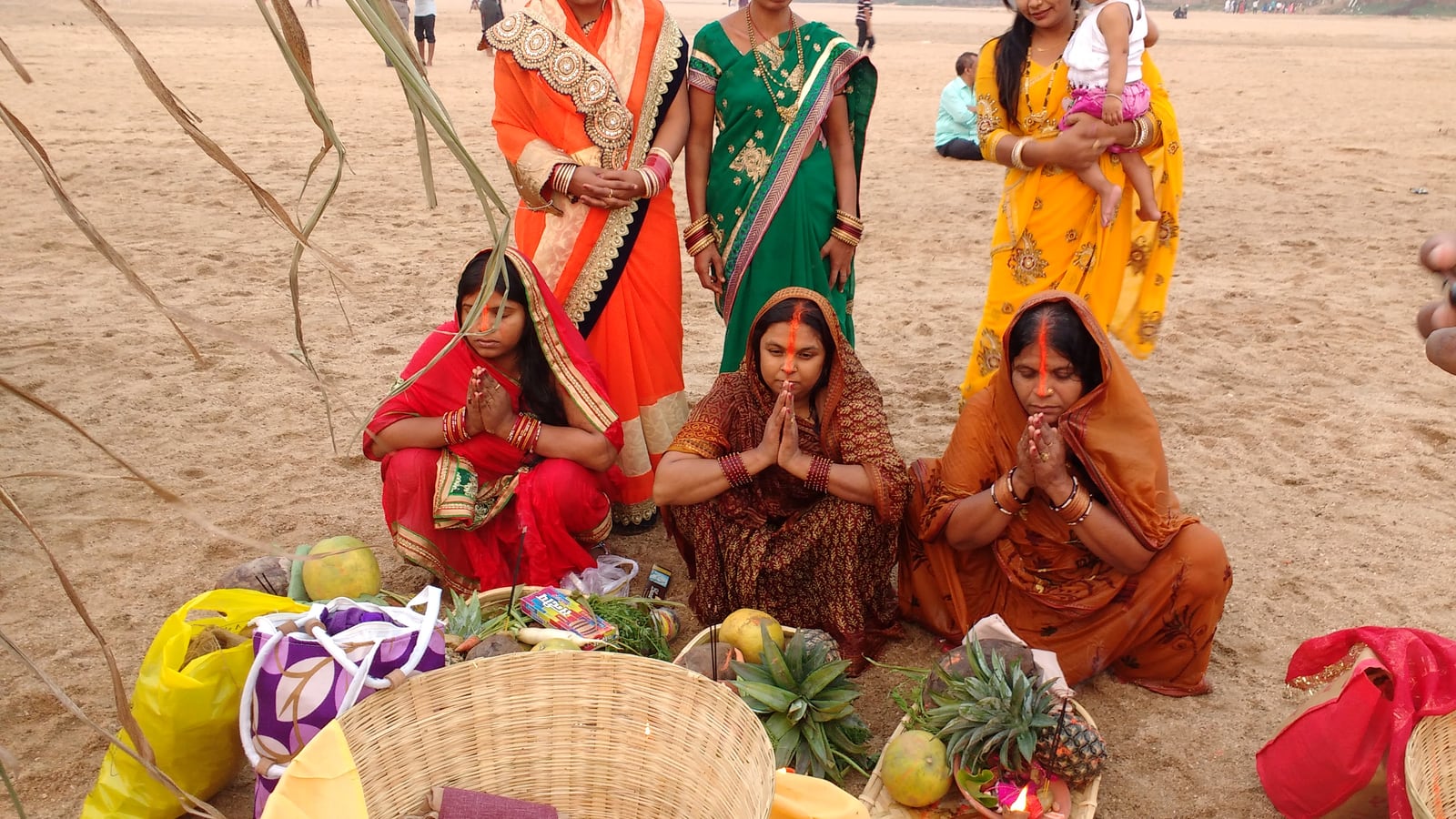
- Sandhya Arghya — Sunday 15 November. In the late afternoon the family walks to the water and, as the sun sets, offers arghya — raising a soop, a bamboo winnowing tray heaped with sugarcane, coconut, seasonal fruit and thekua, the stiff wheat-and-jaggery biscuit that is the taste of the festival. In Patna the sun sets around 5:02pm that evening; wherever you are, the offering is timed to your own sunset.
- Usha Arghya — Monday 16 November. Before dawn the family returns to the water and offers arghya to the rising sun. Only then, after some thirty-six hours, does the fast break.
Exact sunrise and sunset times shift with your city — a panchang will give you the minute for London, Toronto or Chicago.
Why this, of all festivals, travels
Because it needs no temple and no priest, Chhath is portable in a way that Durga Puja, with its pandals and clay idols, is not. All it asks for is water, a sunrise, and a family willing to do the work. That is a specification a diaspora can meet.
And it does. In the United States, one of the largest Chhath gatherings takes place each year at Donaldson Park in Highland Park, New Jersey, on the banks of the Raritan River, run for over a decade by the Bihar and Jharkhand Association of North America; on the appointed evening hundreds of families carry their soop down to the water exactly as they would at a ghat in Patna. The festival is now kept, by lakesides and in back gardens, across the United Kingdom, Canada and Australia — wherever the Bihari and Maithil diaspora has settled.
There is a longer thread here, too. The girmitiyas — the indentured labourers shipped from this very region to Mauritius, Trinidad, Fiji and Guyana in the nineteenth century — carried the festival with them. A child in the diaspora keeping Chhath today is not doing something new. They are the latest link in a chain of people who kept the sun-festival alive a long way from the Ganga.
Keeping it far from the river
Here is the honest, practical part — the reason this belongs in a section for diaspora families rather than a devotional manual.
You do not need the Ganga. You need clean water and a safe place to stand at the edge of it. A lake, a slow river, a park pond, the sea — all have served. Where there is nothing suitable outdoors, families have offered arghya in a garden, into a clean tub or an inflatable pool filled for the purpose, or, in a small flat on a cold November morning, a bathtub. None of this is a lesser Chhath. The festival was always about the sun and the discipline, not the specific river.
Two cautions worth saying aloud to anyone doing it abroad for the first time. Mid-November water in the northern hemisphere is cold and often unsafe to wade into — do not send an elder or a child into a strange lake at dawn for the sake of authenticity; offer from the edge, or from water you have prepared. And a thirty-six-hour fast without water is genuinely demanding; older relatives, and anyone attempting it in a harsh climate, should treat their health as the higher law. The festival honours devotion, not injury.
How to explain it to a child
Keep it simple and keep it true. Chhath is a thank-you to the sun for light and for food — the two things that keep everyone alive — and a wish, above all, for the health of children. It is the one festival you can do without a building, a statue or a priest, which means you can do it anywhere in the world. And it is hard on purpose: the fast is difficult so that the thank-you means something.
Then let the child do it with you, not watch it. Give them the soop to hold. Let them help press the thekua dough or wash the sugarcane. A child who has stood sleepy at a New Jersey lake before sunrise, holding a bamboo tray of fruit up to the first light, has understood more about the festival than any explanation could give them.
And play the songs
Finally, play the music. For two generations the sound of Chhath has been the voice of Sharda Sinha, the singer from Bihar known as Bihar Kokila — the cuckoo of Bihar — who recorded dozens of Chhath songs before her death in November 2024. Her chhath geet carry the Maithili and Bhojpuri of the region, and a child who does not yet speak either will still learn the tunes — which is how a language survives a generation abroad: one festival song at a time.
The sun rises on New Jersey and on Patna alike. That, in the end, is the whole theology a diaspora child needs — the thing the family is thanking is the same sun, seen from a different shore.