

Onam, explained for a child who has never seen Kerala
Kerala's great harvest festival falls on 26 August this year — the day a good king comes home. What Onam means, when its ten days run in 2026, and how to give it to a child growing up far from Kerala.
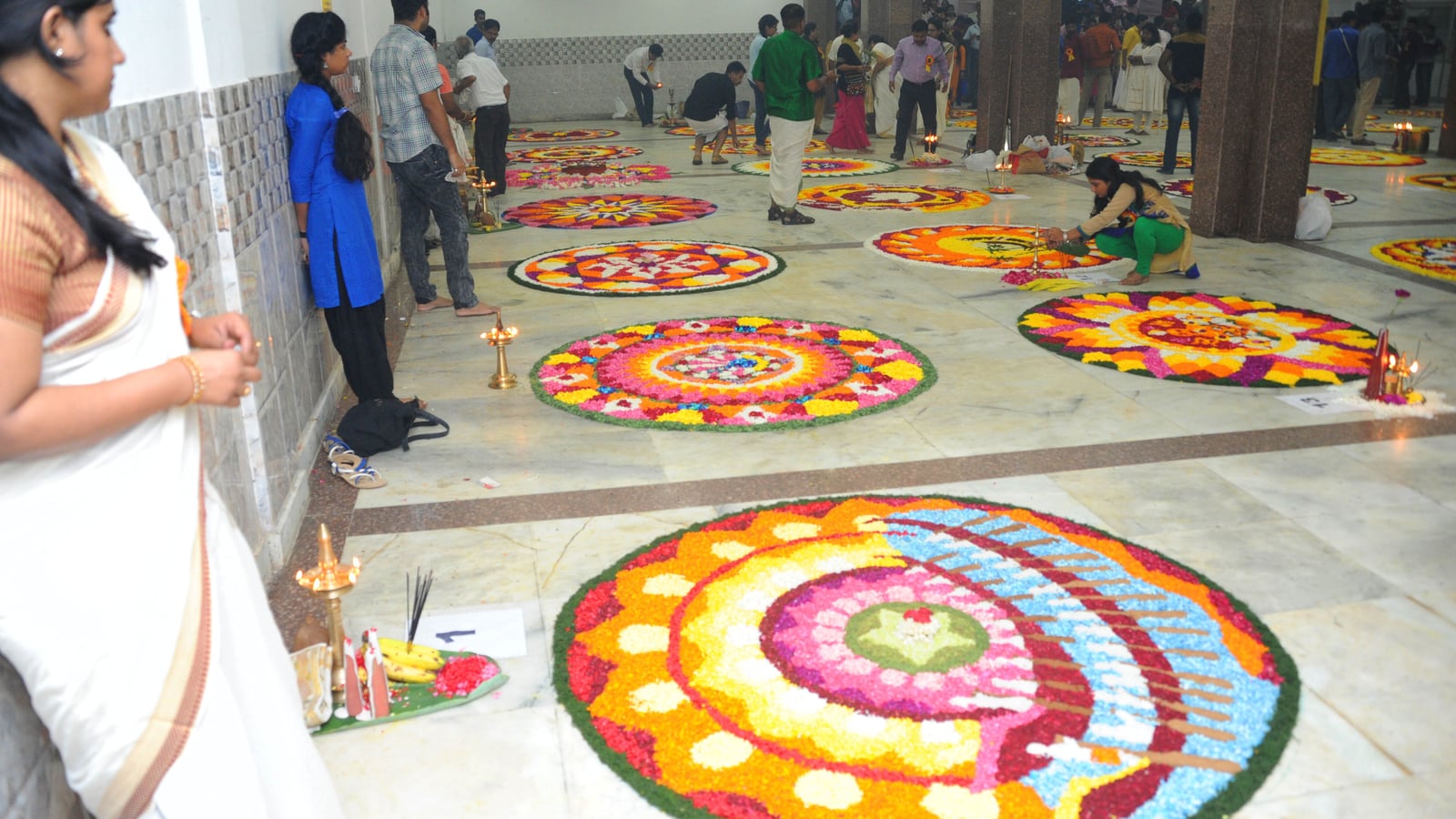
The child's question comes as you kneel on the floor, sorting marigold heads into little piles: who are the flowers for?
The honest answer is that they are for a king who died thousands of years ago and comes home once a year. On 26 August this year, families across Kerala — and across the Malayali diaspora, from Dubai to New Jersey — will lay a carpet of flowers at their doorstep and cook a feast to welcome him. This is a guide to explaining that to a child who is growing up far from Kerala: what Onam is, when its ten days fall in 2026, and how to give it to a child who has never seen a paddy field.
The festival of a good king's homecoming
Onam is Kerala's great harvest festival, and its heart is a story. It remembers Mahabali — in Malayali memory a wise and generous king under whom Kerala knew a golden age, when, as the old song goes, all people were equal and there was neither want nor deceit. The gods, unsettled by his popularity, sent Vishnu in the form of a small brahmin boy, Vamana, who asked for three paces of land and then grew vast enough to cover the earth and sky in two — pressing Mahabali down to the netherworld with the third. But the king was granted one wish: to return, once every year, to see that his people are still happy. Onam is that visit. The flowers, the feasts, the new clothes are a people showing their old king that all is well.
It is worth telling a diaspora child one more thing about Onam: in Kerala it belongs to everyone. Hindus, Christians and Muslims keep it together as a Kerala festival, not only a religious one — which is exactly why it travels so well into a mixed, secular life abroad.
Ten days, and when they fall in 2026
Onam runs for ten days, from the star Atham to Thiruvonam. In 2026 that is 16 to 26 August, with Thiruvonam — the main day — on Wednesday 26 August. The festival builds across the ten days, and so does the flower carpet: a small ring on the first morning, a little larger and more intricate each day, at its grandest on Thiruvonam.
What a family actually does
- The Pookkalam — a circular carpet of flower petals laid on the floor or doorstep, added to daily. It is the one custom made for children: no skill required, only hands and colour.
- The Onam Sadya — a grand vegetarian feast served on a banana leaf, traditionally two dozen or more dishes, eaten with the hands, ending in sweet payasam.
- Onakkodi — new clothes for the family, worn on Thiruvonam.
- And, in Kerala, the spectacle: Vallam Kali, the snake-boat races rowed by a hundred oarsmen, and Pulikali, dancers painted as tigers.
Why Onam travels so well
Few Indian communities have gone as far or in such numbers as Malayalis. Kerala has long sent more of its people abroad than almost any Indian state — above all to the Gulf, where millions live and work, and in large numbers to the United States, the United Kingdom, Canada, Singapore, Australia and Europe. Wherever they have settled, the Onam Sadya has followed, cooked in community halls and living rooms on a borrowed banana leaf or a green plastic stand-in. (For the wider picture of that migration and the money it moves, see our Gulf NRI money guide.)
Because Onam needs no temple and no priest — only flowers, food and a family — it survives the crossing almost intact. A pookkalam laid on a tiled floor in Sharjah or Houston is doing exactly what one in Kochi does.
Keeping it far from Kerala
You do not need Kerala's flowers. A pookkalam can be built from whatever a supermarket or garden offers — marigolds, roses, chrysanthemums, even petals pulled from bouquets — and the making of it is the point, not botanical accuracy. The sadya can be cooked over a weekend, shared potluck-style with other families, or ordered from a Kerala restaurant where one exists. And the Mahabali story can be told in five minutes over the flowers.
The one thing worth protecting is the spirit of it: Onam's oldest idea is equality and welcome, so it is a festival to open to neighbours — the more leaves at the table, the more like Kerala it feels.
How to explain it to a child
Keep it to the story, because the story is enough. There was once a good king, you say, and when he ruled, everyone was equal and no one went hungry. He had to leave, but he loved his people so much that he is allowed to come back and visit just once a year. We lay the flowers to show him the way home, and we cook the feast so he can see we are doing well. A child who has helped press a ring of marigolds into a spiral, and who knows the good king is coming to check on them, has understood Onam better than any lecture could manage.
The same king, in the old belief, visits every Malayali home on the same day — the one in Kochi and the one in Croydon alike. That is the whole of it: the festival is portable because it lives in a floor of flowers and a leaf of food, and both can be laid anywhere in the world.
Building your family's festival year abroad? See our companion guide, Chhath explained for a diaspora child.