


Robin Leo Hoffmann: the German who went looking for an Aghori — and found a way to live
He first touched India at two and a half, went back alone at eighteen, and returned a decade later to sit with an Aghori monk in the lanes of Varanasi. Robin Leo Hoffmann of the Still Human podcast on sadhana, seva, samadhi — and the monk who told him a better world is simply ours to build.
By Diaspora Dreams Newsroom · Interview by Chandan Kumar Singh ·


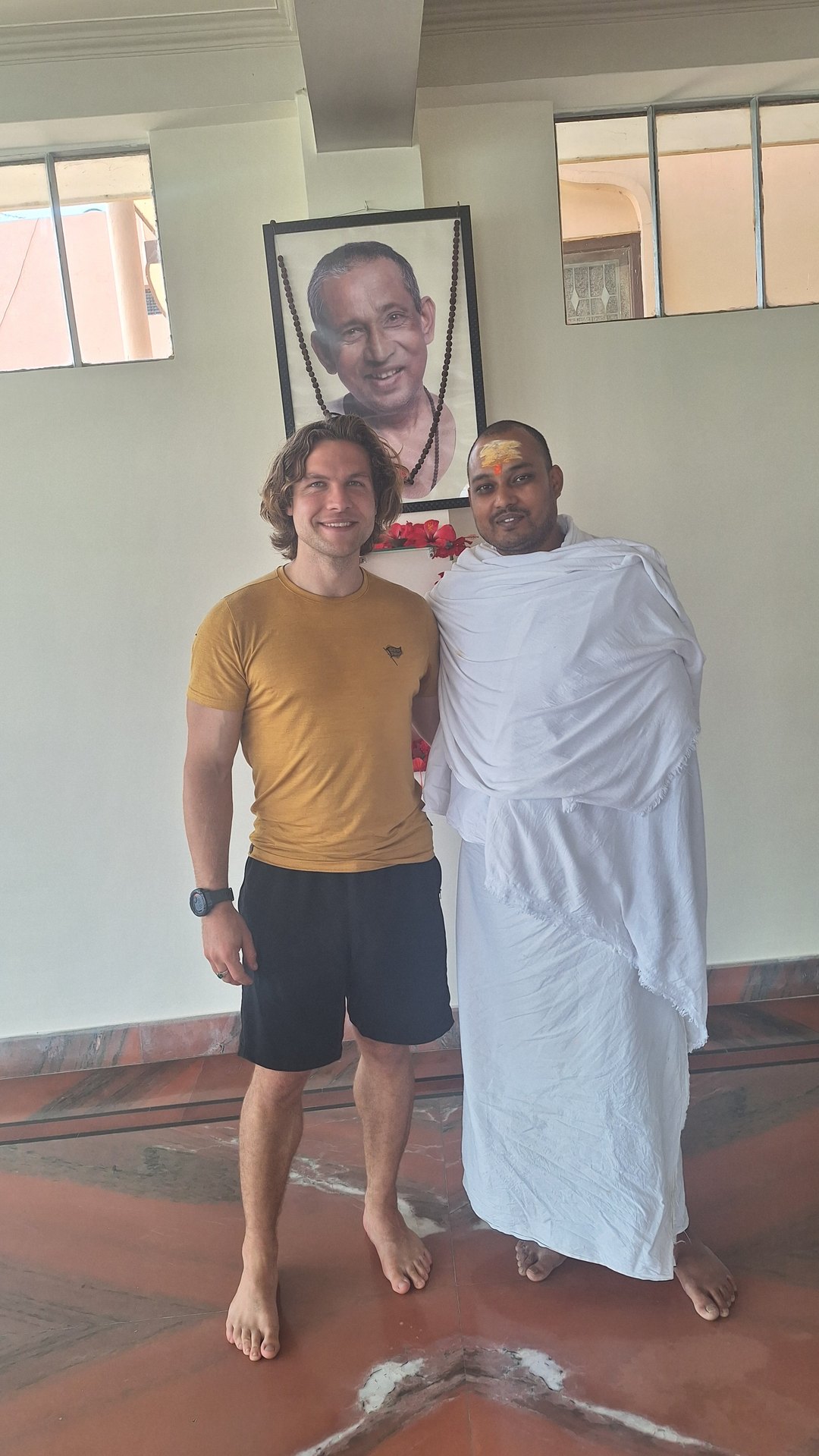
Some people discover India. A few are claimed by it before they can remember. Robin was two and a half when his mother carried him through the country on a trip he has no memory of — but which, by his own telling, set the direction of his life. He went back at eighteen, straight out of school, and wandered from Tamil Nadu up to Rishikesh with a curiosity he could not yet name, standing in front of temples "mesmerised," certain that something was happening there he would one day understand. He came back a decade later with a microphone and a plan, and went looking — in the lanes of Varanasi — for an Aghori.
The Aghoris are among the most misread figures in Indian spiritual life: the cremation-ground ascetics the West has flattened into a horror-show of skulls and ash. What Robin found at the Aghor Foundation's ashram was something quieter and stranger — a reformed order building schools and farms, and a teacher he calls Sadhu Ji who sleeps three hours a night and starts his mornings, of all things, with something close to affirmations. The meeting became an episode of Robin's podcast, Still Human. But as he says, an episode is "only the tip of the iceberg of the experience."
We spoke to him — Robin Leo Hoffmann, a German writer and the voice behind the Still Human podcast — for our In Conversation series. Not because he is Indian (he is a German, raised, as he puts it, in a Christian country) but because he is, in the way this publication cares about, Indian in essence: an outsider who went deep enough into a tradition to carry it back out into the world.
"I knew I would come back"
You first touched India as a toddler. When did it become a choice?
When I was very young, between two and a half and three, my mother travelled to India with me and my older brother. I don't remember much of it, but apparently it impacted me a lot. When I finished school at eighteen, I wanted to go — so a few months later, I went. A curiosity about spirituality, an openness toward traditional depth, were always there. I started in the south, in Tamil Nadu, and went on to Kerala, Mysore, Hampi, Maharashtra, Rajasthan, Delhi, Rishikesh and more. My last stop was Varanasi. I was often standing in front of temples or spiritual sites, mesmerised. I knew something was going on there that I couldn't understand yet, at nineteen — but I knew that one day I would actually experience it. When I came back ten years later and started in Varanasi, it was clear I wanted to speak to an Aghori. So I just asked everyone on the streets, found many Aghoris — many with very broken or no English — and eventually I was recommended to the Aghor Foundation, which hosted me in their ashram and let me interview their Sadhu Ji.
Two days in the ashram
The podcast is one conversation. You were there longer. What did those days feel like?
The episode is only a glimpse, an echo of the whole encounter. I stayed two days and had many conversations with Sadhu Ji. I didn't only witness a very peaceful, almost limitless energy — I got infected by it. I needed far less sleep the whole time in Varanasi; four to five hours were enough, and Sadhu Ji sleeps about three. He told me many stories — including one about how his guru once threw him out onto the street, not allowing him to beg, not allowing him to ask for money or food. He was only allowed to receive what was offered to him. His guru left him there for years, until he decided Sadhu Ji had learned what he needed, and took him back.
He spoke about "collecting himself." In the morning he opens himself up with rituals, and in the evening he collects himself — because, as he said, "throughout the day you meet many people, and parts of you are scattered in these encounters, and therefore scattered in the world." He has let go of the thoughts that doubt, that imagine a good or bad future, that replay the past. He only lives in the present moment. That's why he has so much more energy, and needs so little sleep. He didn't say it to brag. I was just asking, because in the evenings I was exhausted and in the mornings everyone was already doing yoga.
On samadhi
Sadhu Ji said we all pass through samadhi and simply don't notice. Did that land for you?
Many people have tried to put samadhi into words, and I don't dare make another attempt. But in that state — which can last seconds, minutes or hours — you are fully present in your senses, without distraction. I definitely felt what he was describing. Once you've felt it, you can always come back to it, through meditation, through breathwork, sometimes just sitting in nature or hiking. I wouldn't say I've mastered it, or that I'm an expert. I got a little taste — and ever since, life offers me its sweetness, the non-judging, serene sweetness of samadhi, once in a while.
Everything he'd assumed, undone
You'd arrived with ideas about what an Aghori was.
It undid most of them. A day earlier I'd met a Naga Baba, a naked Aghori who owned nothing but his guru certificate. I sat with him an hour and nothing felt important; mostly we just stared at the Ganges. There are many "show Aghoris" in Varanasi who play with the mysticism built around them — they're like a tourist attraction, and once you look, they want money. But no Aghori is like any other. In the ashram it was completely unexcited. If you hadn't known Sadhu Ji was an Aghori, you might not even have recognised him.
His guru had changed the course of the path. He realised that if Aghoris only scare people — if they only evoke shame, disgust, disdain — they aren't serving their purpose. So he kept the philosophy and changed some of the daily customs. From his point of view, an Aghori exists only to serve humanity. And that's what I witnessed: they were building schools, running farms, growing their own food, feeding the community, taking children off the street, educating them, giving them a home. One evening I slipped into a kind of melancholic exhaustion and told Sadhu Ji I wished for a world where we all lived the values of that ashram. He just looked at me lovingly and said: "We just have to do it. We can create exactly this world." Then he smiled, turned to one of the ashram's children, threw him a funny line, and went on playing.
Sadhana and seva
What surprised you most in what he taught?
In the West, "affirmations" became popular in the last few years — and Sadhu Ji starts his mornings with what are, essentially, affirmations. A mantra, of course, but the similarity was striking. And the idea of freeing yourself from unnecessary thought, and so having more energy and time to serve others, felt like the true goal of a human being.
There are two principles, and if you devote yourself to them you've mastered everything. Sadhana — personal practice; meditation, breathwork, yoga, something simple enough to do every day — through which we feel our wholeness. And maybe one day we're so nourished that our pot overflows, like a river that has more than enough water for itself, spills its banks and nourishes them. That's seva — selfless service. Two tasks, really: first, recognise your limitless, pure essence; second, find a form in which you want to serve humanity.
I'm still a bit sceptical about rebirth — intellectually I can't yet grasp it. But if there's one thing I understand more and more, it's why we're here. I never felt any pressure in that ashram. They welcomed me like one of their own.
To the ones who inherited it
Many of our readers are children of the diaspora, raised with these traditions half-understood. What would you say to them?
When you're born into a culture or tradition, you tend to value it less. I was born in a Christian country, and though there's much wisdom in the Bible, I never really valued it. Travelling in India, I noticed a lot of young people still have some belief, but it's not as rooted as it could be — sometimes I wasn't sure whether they believed it or just did it, because that's what you do. It's a habit. And yet I've never seen a country with so many spiritual texts, full of contradictions and clarity at once, where people still study the Vedas and Vedanta today. It's natural to want to explore the new, the unknown — so why explore your own religion? But I met many young people who know so much about yoga, the legends of the gods, Ayurveda. When I told people in my hostel I was going to meet an Aghori, some flinched: "Be careful, take a mantra with you." They were twenty years old. The culture is incredibly diverse — but the knowledge is timeless, and it should be treated as such.
Still Human
And the podcast itself?
I truly believe everyone can learn from everyone — everyone on this planet understands at least one thing, usually more. I look for people who understand a lot, go to their places, and interview them in their lives. I get a lot back from every episode; it's an exchange. For the next one I went into a twenty-one-day teaching in Kathmandu, which also wasn't planned. So far I do almost everything alone, and I'd love to grow it — find sponsors, build a team. You can find Still Human on YouTube, Spotify and wherever you listen to podcasts.
This interview was conducted for Diaspora Dreams by Chandan Kumar Singh. Robin's written essays on the encounter — "Aghori Monk, Varanasi" and "Varanasi Is a Frequency" — appear on his Substack. Answers have been edited for length and clarity; his words have not been changed. Photographs courtesy of Robin / Still Human.