

Do you need to re-issue your OCI card? The 2026 rules
Mostly no — India scrapped the old 20-and-50 re-issue rule in 2021, and the 2026 e-OCI is digital. But a new passport still starts a 90-day clock to update your details online, or a US$25 fine. The 2026 rules, untangled.
It is the question that fills NRI WhatsApp groups every time someone renews a passport: now that I have a new one, do I have to get my OCI card re-issued? In 2026, for most people, the answer is finally no. But a smaller obligation has quietly taken the old rule's place — and a fine for ignoring it — so it is worth knowing exactly where you stand.
The rule people still fear
For years the OCI card carried a re-issue requirement tied to your passport, and it caught people out constantly. The card had to be re-issued — a fresh application, a fresh card — every time you were given a new passport up to the age of 20, and once more after you turned 50. The logic was biometric: a face changes most in childhood and again in later life, and the card's photograph had to keep up. In practice it meant parents re-applying for a toddler's OCI every few years, and older holders discovering at an airport that their card was technically out of date.
What changed in 2021
That regime is gone. In a circular dated 31 August 2021, India's Ministry of Home Affairs dispensed with it. In the official wording, "the mandatory requirement of re-issuance of an OCI card each time a new passport is issued to a foreigner up to 20 years of age and once after completing 50 years of age, is dispensed with."
What replaced it is far lighter:
- If your OCI was issued before you turned 20, you must re-issue it only once — when you get a new passport after completing 20 years of age. One re-issue, in your early twenties, and you are done.
- If your OCI was issued after you turned 20 — as it was for most adult applicants — you never need to re-issue it at all, however many passports you go through. The old "once after 50" requirement no longer applies to you.
What 2026's e-OCI changed
The 2026 overhaul made the question moot for almost everyone. India notified the Citizenship (Amendment) Rules, 2026 and, on 30 June, switched on a fully digital e-OCI — a digital record that replaces the blue booklet, with printing of the physical card discontinued. There is no longer a booklet to re-stamp into a passport, so the re-issue question in its old form has largely dissolved. Most existing holders can move to the digital record without a fresh application or physical verification.
The digital card also cuts the oldest travel headache. Each holder now gets a unique registration number, so the OCI is no longer tied to one specific passport booklet — the long-standing hassle of carrying both the old passport the card was issued against and your current one eases considerably.
The catch that replaced it
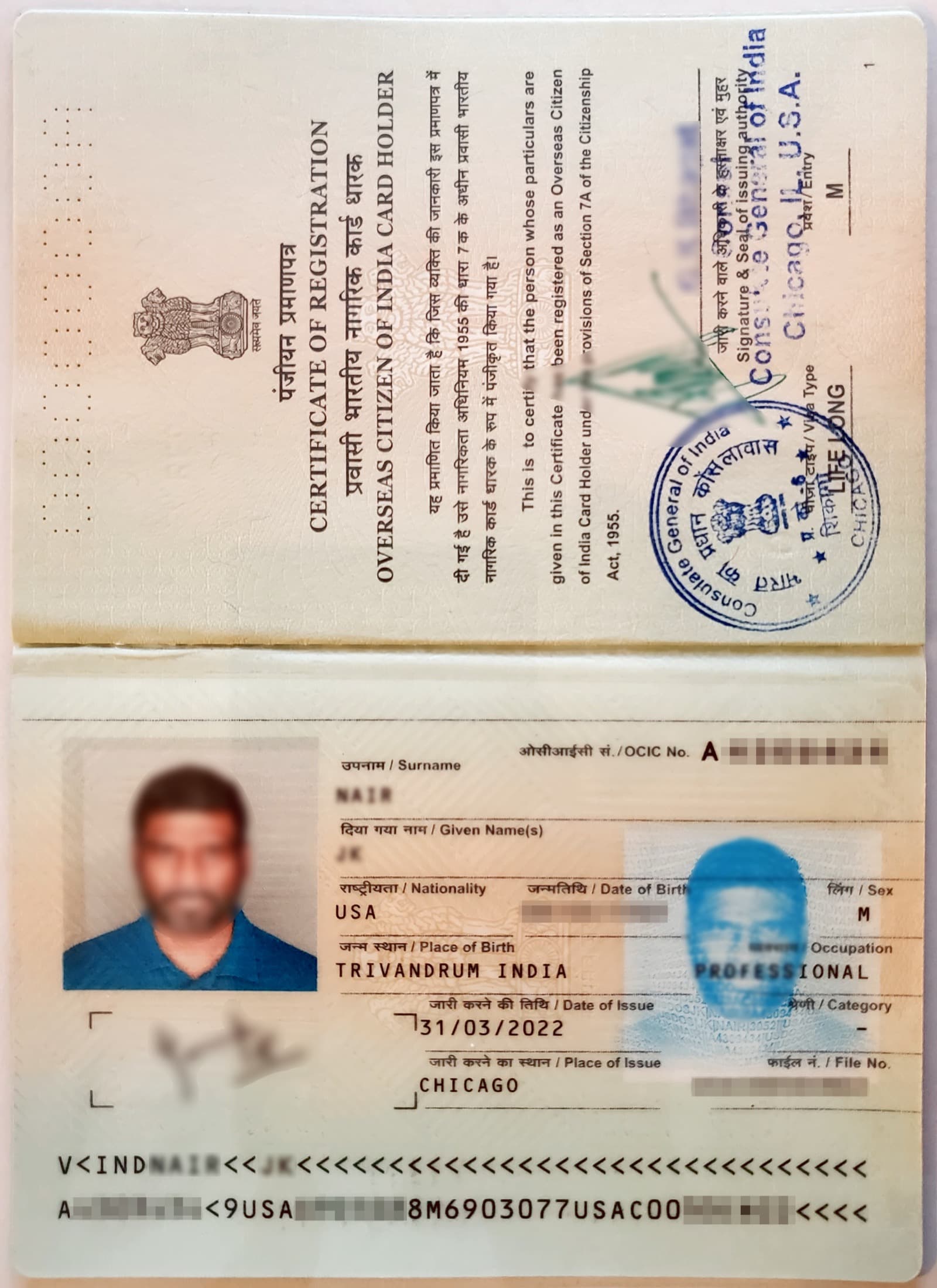
Here is the part that trips people up now. Even when you do not need to re-issue the card, you are still required to update your details online — to upload, through ociservices.gov.in, a copy of your new passport and a recent photograph — each time you are issued a new passport up to the age of 20, and once after completing 50. You have three months from receiving the new passport to do it, and the update itself is free ("gratis").
Miss that window and there is now a price. Under the 2026 rules, an OCI holder who fails to update new passport details within three months of receiving the passport faces a US$25 fine, or the local-currency equivalent, as the immigration firm Fragomen has noted. The sum is small; the principle is new. For a document millions have long treated as set-and-forget, a new passport now starts a 90-day clock.
What it costs
The online update is free. The one re-issue that some holders still need — the single one after turning 20, for those whose OCI was issued as a minor — carries the standard charge: a US$275 government fee is for a fresh registration, but a re-issue is cheaper, at US$25 plus a $3 Indian Community Welfare Fund levy and a VFS service fee of around $16, before any courier extras. Service fees vary by country and mission, so confirm the figure for your jurisdiction.
So — do you need to re-issue? A quick test
- Got your OCI as an adult (after 20)? No re-issue, ever. For most adults neither upload window (before 20, or after 50) applies either, so there is nothing to do but keep a copy of each new passport on file.
- Got your OCI as a child (before 20)? One re-issue — when you get your first passport after turning 20. Until then, upload each new passport online within three months.
- Just renewed a passport? Check the 90-day clock. If you fall in one of the upload windows, log in to ociservices.gov.in and update — it is free, and it is the single thing most likely to cost you $25 if forgotten.
An OCI linked to a passport number you no longer hold has caused families grief at check-in for years. The 2026 rules make the card itself almost maintenance-free. What they ask instead is small but real: not that you re-apply, but that you remember — and they now attach a fine to forgetting. If you are only now getting into the system, start with our guide to applying for an OCI card in 2026; if you are unsure what the card actually entitles you to, we have set out what an OCI is, and isn't.
Sources: the Consulate General of India, Chicago's OCI re-issue guidelines (press release, 31 August 2021) and India's Ministry of Home Affairs circular on the relaxed re-issue requirement, quoting the dispensation of the up-to-20 and after-50 rule, the once-after-20 re-issue for those issued OCI as minors, the three-month online passport-update requirement via ociservices.gov.in, and the re-issue fee breakdown ($25 + $3 ICWF + ~$16 VFS). India's Citizenship (Amendment) Rules, 2026 and the e-OCI digital system (live 30 June 2026), with the unique registration number and the US$25 fine for failing to update within three months, as detailed in our guide to the 2026 e-OCI rules and noted by the immigration firm Fragomen. Fees and windows vary by country and mission; confirm the current figures for your jurisdiction before acting.