

Temples of the Diaspora: BAPS Neasden, the stone temple London didn't expect
In a corner of north-west London, a Gujarati congregation built Europe's first traditional Hindu stone temple — 5,000 tonnes of hand-carved marble and limestone, raised entirely by the community.
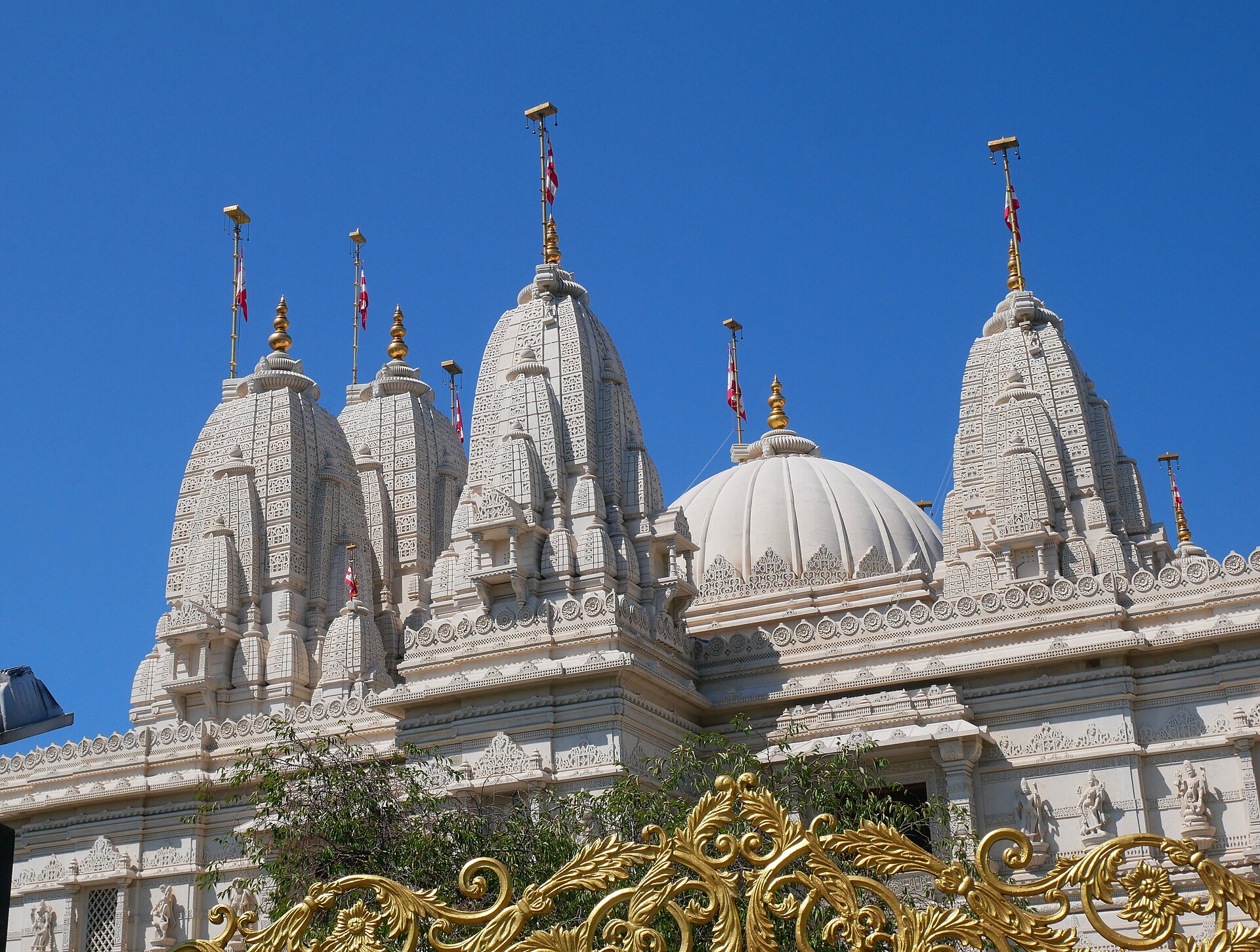
In the ordinary north-west London suburb of Neasden, between an industrial estate and the North Circular Road, stands one of the most improbable buildings in Britain: a gleaming temple of Italian marble and Indian craftsmanship that looks as though it has been lifted intact from Gujarat and set down among the terraced streets. When it opened in 1995, the BAPS Shri Swaminarayan Mandir became Europe's first traditional Hindu stone temple — and a turning point in the story of Hindu Britain.
A temple carved on two continents
The Neasden Mandir was built the old way, by the rules of the ancient shilpa shastra texts, using no structural steel. Its raw material was extraordinary: 2,828 tonnes of Bulgarian limestone and 2,000 tonnes of Italian marble were quarried in Europe and shipped to India, where a team of some 1,526 sculptors hand-carved them into roughly 26,300 individual pieces. Those pieces were then sent to London and assembled, like a colossal three-dimensional jigsaw, on the Neasden site. The whole project cost around £12 million, much of it raised by the community, and was completed in only a few years.
Pramukh Swami's vision
The temple was inaugurated in 1995 by Pramukh Swami Maharaj, the spiritual leader of BAPS, whose vision drove the project. It belongs to the Bochasanwasi Akshar Purushottam Swaminarayan Sanstha, the same Gujarat-rooted Swaminarayan order that would, decades later, build the giant Akshardham temples in New Delhi, Gandhinagar and — in 2023 — Robbinsville, New Jersey. Neasden was, in a sense, the prototype for that global ambition: proof that an authentic stone mandir could be raised far from India by the labour and money of the diaspora.
Why it mattered
Before Neasden, Hindu worship in Britain happened largely in adapted spaces — converted houses, former churches, repurposed warehouses. A purpose-built temple in traditional stone changed the symbolism entirely. It announced that the community was not improvising in borrowed rooms but had arrived to stay, with the confidence and the resources to build something permanent and beautiful. For British Hindus it was a moment of collective coming-of-age.
The twice-migrants who built it
Much of the congregation it served had reached Britain by a long route. A large share of London's Gujarati Hindus are "twice-migrants" — families who had settled in East Africa over earlier generations and were then expelled or pressured out of Uganda, Kenya and Tanzania in the 1960s and 70s, arriving in Britain with little. Within a single generation, that uprooted community had established itself well enough to fund and raise one of the most ambitious religious buildings in the country. The temple is, among other things, a monument to that recovery.
More than a place of prayer
The complex is not only a mandir. Beside the temple stands a haveli, a cultural centre built in intricately carved Burmese teak and English oak, housing an assembly hall, and the site includes a permanent exhibition, "Understanding Hinduism," along with classrooms, offices and community facilities. It functions as the hub of a large and active congregation — a place of worship, education and gathering rolled into one.
A landmark of London
Neasden quickly transcended its own community to become a London landmark, regularly listed among the city's man-made wonders and a fixture on tourist itineraries. It has received royalty and heads of state, appeared in countless photographs of multicultural Britain, and stands as one of the most recognisable Hindu buildings in the Western world — a marble apparition that still stops first-time visitors in their tracks.
The volunteer model — and its questions
Like its later cousins, Neasden was built on the BAPS model of seva, the devotional volunteer labour the order holds central. That same model would later draw scrutiny: the construction of the order's New Jersey Akshardham became the subject of a major US lawsuit alleging that imported Indian workers were underpaid and exploited, a case the Department of Justice ultimately dropped in 2025 without charges. No such allegations attach to the Neasden temple itself, but the controversy abroad has prompted wider questions about how the diaspora's grandest monuments are actually built, and at what human cost.
A permanent address
Three decades on, the Neasden Mandir remains what it was designed to be — a permanent address for Hinduism in Britain, carved in stone to outlast the generation that raised it. It set the template that BAPS would carry around the world, and it gave a community of twice-displaced migrants something their wanderings had long denied them: a place that was unmistakably, monumentally, theirs.
Continue the series · Temples of the Diaspora
Related from Culture

The diaspora on your feed: the Indian-origin names to follow right now

From Merle Oberon to the red carpet: a century of Indian-origin women in the spotlight

Asmi Aderay, the Hyderabad-to-LA singer who refuses to pick one genre