

Sri Mariamman: the South Indian goddess at the heart of Chinatown
Behind a tower crowded with painted gods, in the middle of Singapore's Chinatown, stands the city-state's oldest Hindu temple — founded in 1827 by a clerk who sailed in with Stamford Raffles, and still the spiritual anchor of Tamil Singapore.
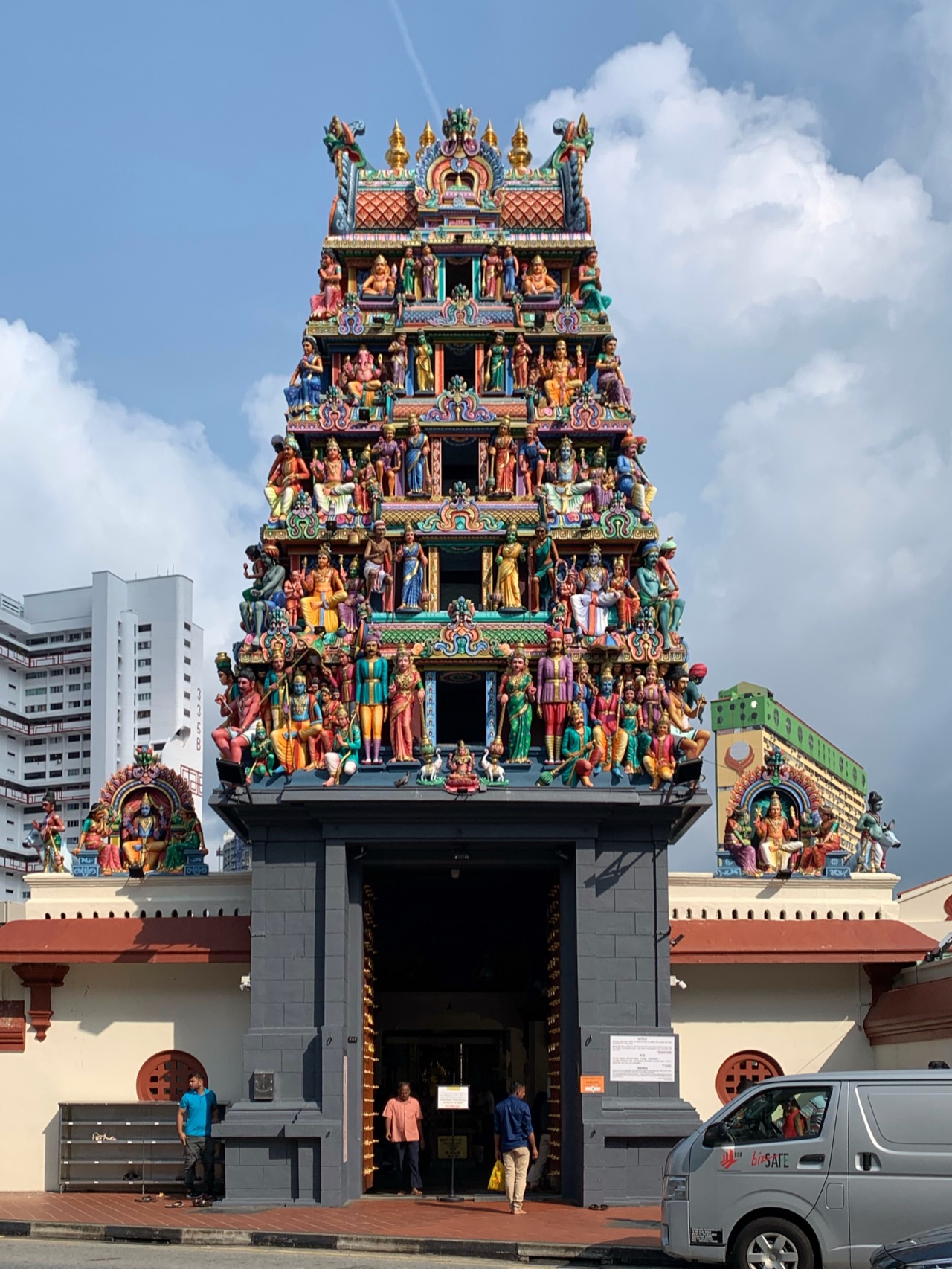
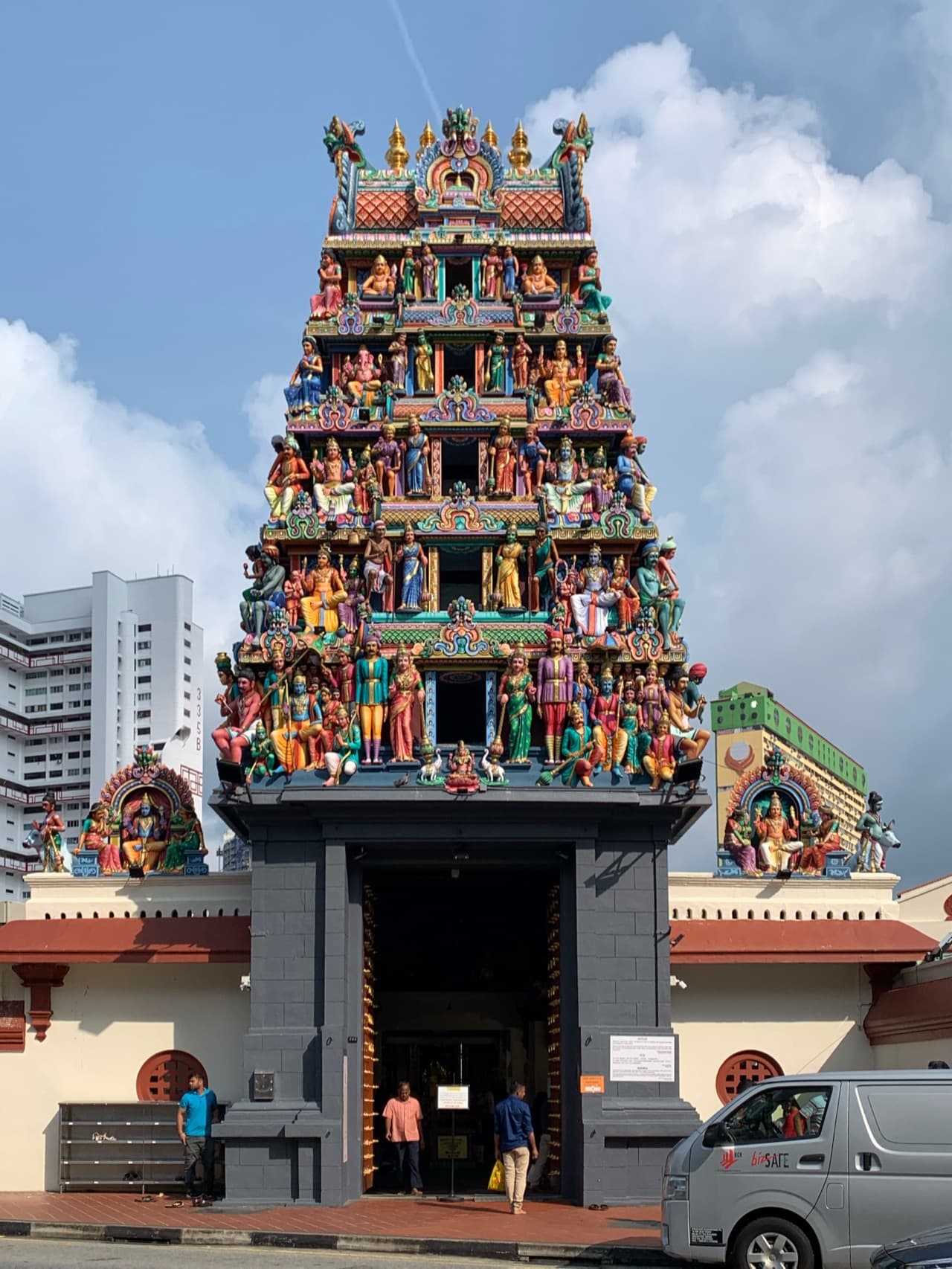
Walk through Singapore's Chinatown — past the shophouses, the clan associations and the Buddhist temples — and you come, improbably, upon a towering gateway swarming with brightly painted Hindu deities. This is the Sri Mariamman Temple, the oldest Hindu temple in the city-state, a piece of South India set down in the heart of the Chinese quarter — and a monument to the small, founding-era Tamil community that built it.
A temple older than most of the city
Sri Mariamman was founded in 1827 — just eight years after the East India Company established its trading post on the island — by Naraina Pillai, a government clerk and merchant who had arrived from Penang with Sir Stamford Raffles on his second visit to Singapore in 1819. Pillai became a leader of the early Indian community, and on a plot along South Bridge Road he raised a simple shrine of timber and attap thatch, installing in it an image of the goddess Mariamman. The wood-and-thatch temple was rebuilt in brick and plaster over the following decades into the structure that stands today.
Why Mariamman
The choice of deity is itself a piece of diaspora history. Mariamman is the great mother-goddess of rural South India — guardian against disease, bringer of rain, protector of the vulnerable. She was the deity of the Tamil labouring classes, the people who made up the bulk of the Indian migration to Malaya and Singapore, and it was natural that the goddess who watched over the village back home should be the first to be enshrined in the new land. A temple to Mariamman is a temple of the ordinary Tamil emigrant.
The gopuram
The temple's signature is its gopuram, the soaring tower over the South Bridge Road entrance, built up over the years into six tiers crowded with sculptures of gods, guardians and mythological figures in vivid colour — a textbook of Dravidian temple architecture transplanted whole to the equator. Inside, the boundary wall is topped with figures of sacred cows, and the shrines follow the South Indian plan, a fragment of Tamil Nadu rendered in tropical Singapore.
A Hindu temple in Chinatown
Its location is the great curiosity. The temple long predates Singapore's modern ethnic geography, and it served the Tamil community that clustered near the Singapore River and the commercial district in the colony's earliest years. The Chinatown that grew up around it came later; today the mandir sits, serenely incongruous, among Chinese shophouses and beneath the skyline of the financial centre — a reminder that Singapore's communities were always layered on top of one another, not neatly zoned apart.
Theemithi: walking on fire
Once a year the temple becomes the stage for one of the most dramatic rituals in the Tamil world. At Theemithi, held about a week before Deepavali, devotees walk barefoot across a pit of burning coals laid out in the temple courtyard, fulfilling vows and re-enacting an episode from the Mahabharata in which the goddess Draupadi proves her purity by crossing fire. Thousands come to watch the firewalking, and the ritual binds the modern, high-rise Tamil community to a practice carried from the villages of South India generations ago.
A national monument
In recognition of its age and significance, Sri Mariamman was gazetted a National Monument in 1973, and it is now both a living place of worship — managed under the Hindu Endowments Board — and one of Singapore's most visited heritage sites, drawing tourists who photograph the gopuram between visits to the neighbouring Buddhist temple and the hawker stalls.
The anchor of Tamil Singapore
Indians are the smallest of Singapore's major communities, and Tamils a shrinking share even of that. Yet their oldest institution stands at the literal centre of the island's history, founded within a decade of the colony itself by a man who stepped ashore with its founder. Sri Mariamman is more than a tourist sight in Chinatown. It is the proof, carved in painted stone, that the Tamil diaspora has been part of Singapore's story from the very first chapter — and intends to remain in it.
Continue the series · Temples of the Diaspora
Related from Culture

The diaspora on your feed: the Indian-origin names to follow right now

From Merle Oberon to the red carpet: a century of Indian-origin women in the spotlight

Asmi Aderay, the Hyderabad-to-LA singer who refuses to pick one genre