

The Indians of Burma: how half of old Rangoon vanished from the story
In 1931, nearly half of Rangoon was Indian. Then came riots, a wartime death march, and a dictator's expulsions. The story of Burma's Indians — once the diaspora's richest outpost, now among its most forgotten.
In the 1930s, Rangoon was, by the numbers, half an Indian city. The 1931 census counted more than a million Indians in Burma; of Rangoon's roughly 400,000 residents, over half were Indian. They ran the port and the railways, kept the colonial ledgers, financed the rice trade, and swept its streets. Then, across three decades of riot, war and dictatorship, almost all of it vanished — one of the most complete disappearances in the history of the Indian diaspora.
An Indian province in all but name
For most of the colonial era, Burma was not a country next to India; it was India — governed as a province of British India until 1937. The border was an administrative line, not a real one, and Indians crossed it freely. They came as civil servants, soldiers, river pilots, dockworkers, indentured labourers and traders; after the British annexed Upper Burma in 1885 and the rice economy of the Irrawaddy Delta boomed, southern Indians poured in to work it. By the start of the Second World War, roughly one in six people in Burma was ethnically Indian.
The Chettiars and the money
At the centre of the economy sat the Chettiars — the Nattukottai moneylending caste of Tamil Nadu — who bankrolled the delta's rice farmers. When crops failed and peasants defaulted, the loans were called in, and the Chettiars became among the largest landowners in Lower Burma. Indian dominance of commerce was so complete that in the 1930s Indians paid an estimated 55 per cent of Rangoon's municipal taxes. It was a prosperity that bred deep resentment among Burmese who felt like tenants in their own land.
The city they built
At its height, Indian Rangoon was a world unto itself. The dockworkers who unloaded the rice ships were Telugu and Tamil; the clerks who kept the accounts were Bengali; the traders of the bazaars were Gujarati and Chettiar; the labourers, the pilots, the printers and the police were, in large part, Indian. Downtown Rangoon filled with mosques, temples and gurdwaras — the Mogul Shia Mosque, the Sri Kali temple, the Surti bazaar — and whole streets took the names of the Indian merchants who owned them. Rangoon in the 1920s was one of the great immigrant ports of the world, a city that drew the poor of Madras and Bengal the way New York drew the poor of Europe. For a labourer from a famine-struck Indian district, Burma was not the edge of the world. It was the promised land next door.
Riot, and the long walk
That resentment turned violent. Anti-Indian riots swept Rangoon in 1930 and again in 1938, economic grievance curdling into communal bloodshed. Then came the war. When Japan invaded in 1942, the Indian population fled in one of the great forgotten exoduses of the twentieth century — hundreds of thousands walking overland to India along disease-ridden jungle tracks, in a trek on which large numbers died of exhaustion, hunger and cholera.
Ne Win's expulsion
The community that rebuilt after the war did not survive the dictatorship. General Ne Win seized power in a 1962 coup and imposed the "Burmese Way to Socialism," nationalising every private business in the country. For an Indian community built on trade, finance and shopkeeping, it was ruinous. Between 1962 and 1964, more than 300,000 Indians were pushed out, permitted to leave with almost nothing — their shops, land and savings absorbed by the state. The richest outpost of the Indian diaspora was, within a generation, hollowed out.
What remains
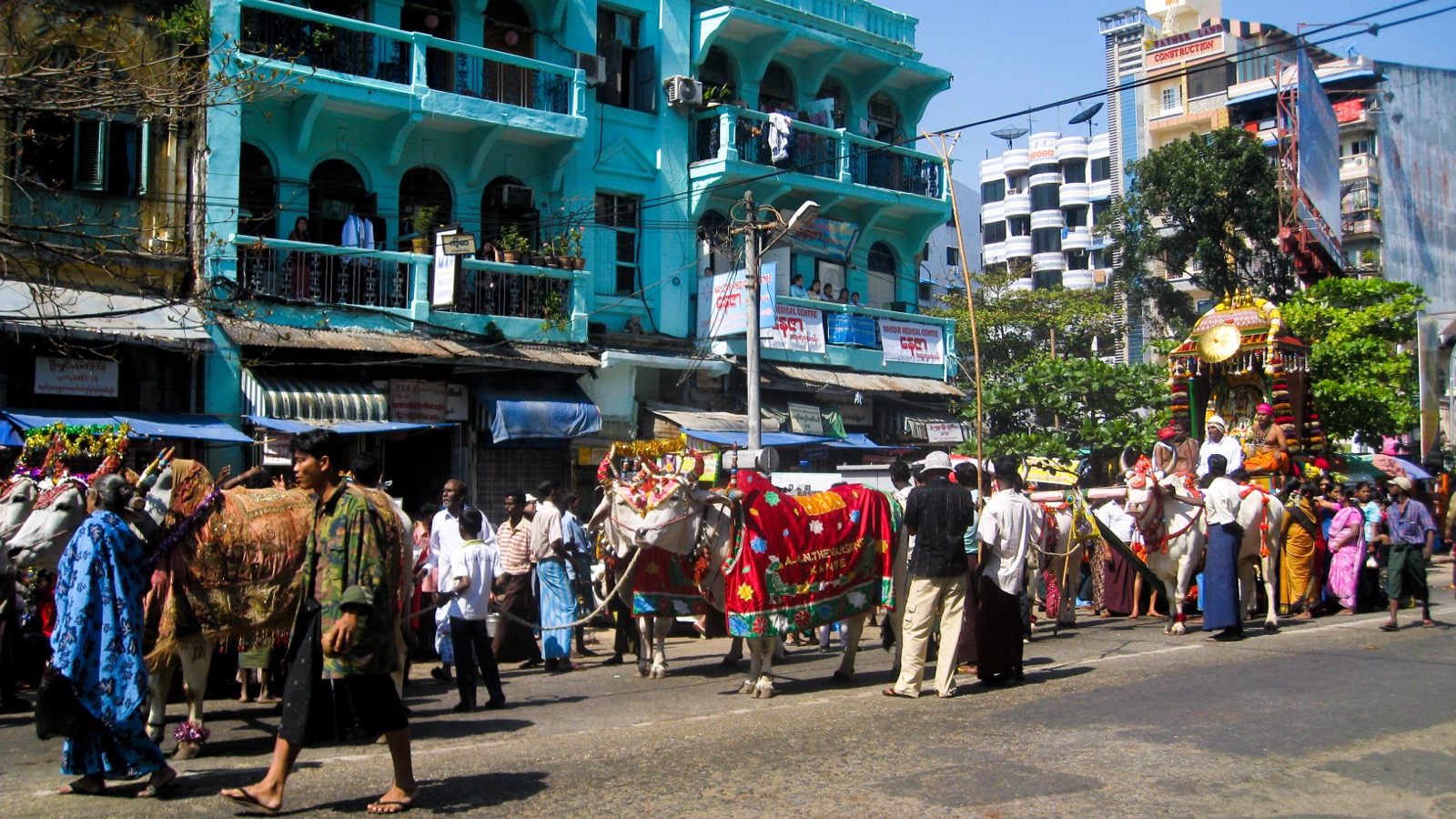
And yet it did not vanish entirely. Perhaps two to two and a half million people of Indian origin remain in Myanmar today — around five per cent of the population — concentrated in Yangon, Mandalay and the old colonial hill towns of Pyin U Lwin and Kalaw. They are Hindus, Muslims, Sikhs and Christians, with Tamil, Telugu, Bengali and Punjabi roots; within that number are several distinct worlds — the Tamil Hindus of the downtown temples, the Bengali and Bihari Muslims, the Gujarati and Chettiar traders, the Sikhs of the old cantonment towns, the Zerbadi community of Indian-Burmese Muslims, and the many mixed Indian-Burmese families whose surnames still carry both shores. The Hindu temples and processions that still fill parts of downtown Yangon, as the photograph above shows, are their most visible sign. But it is a community that learned, across decades of insecurity, to keep its head down — and one that largely lost its living links to India.
The ones who stayed
Those who remained after 1964 learned to live small. Myanmar's 1982 citizenship law recognised a fixed list of "national races" — and the descendants of colonial-era Indians were not on it, leaving many with only associate citizenship or none, and with it a permanent uncertainty about property, movement and belonging. They kept the temples lit and the processions moving, married among themselves, and taught their children to attract as little attention as possible. Their links to India, meanwhile, all but dissolved: few hold the overseas-citizen status that binds other diaspora communities to the homeland, and for most, "back home" is now simply Yangon or Mandalay. The military coup of 2021 only deepened the wariness of a community that has learned, more than once, how fast the ground can shift.
The pattern that came before
There is a longer resonance to the story. Historians and journalists have noted that the expulsion of the Indians was an early instance of the pattern Burma would repeat against later minorities — a state defining belonging so narrowly that whole communities could be declared outsiders and driven out. The Indians of Burma were among the first to learn how quickly a homeland can decide you never belonged.
Half of old Rangoon was Indian. Today most Indians have never heard of it. Burma was the diaspora's wealthiest colony and became its most complete erasure — a mirror image of the other quiet neighbourhood diaspora across the water, the Hill Country Tamils of Sri Lanka.
Related from Heritage
Kundanlal Gupta: the Indian who saved Jewish families from the Nazis
The Lunatic Line: the Indians who built East Africa's railway
‘Girmitiyalogy’: an online symposium on India's indentured migration (10–12 September 2026)