

How Telugu became the fastest-growing language in America
In 2000 there were fewer than 90,000 Telugu speakers in the United States. By the mid-2020s there were well over a million, and Telugu had become the fastest-growing language in the country — the clearest linguistic fingerprint of the tech-era Indian migration.


In the year 2000, the United States was home to fewer than 90,000 people who spoke Telugu, the language of the south Indian states of Andhra Pradesh and Telangana. Two decades later, that number had passed a million, and Telugu had earned a startling distinction: for a stretch of the 2010s it was the fastest-growing language in America, its speaker count rising by 86% in just seven years. No language tells the story of the tech-era Indian migration more clearly.
The numbers
The growth curve is almost vertical. From around 87,500 Telugu speakers in 2000, the population climbed to roughly 223,000 by 2010, 415,000 by 2017, and 645,000 by 2020; by 2024 estimates put Telugu speakers in the United States at about 1.2 million, a fourfold rise in under a decade. Telugu is now, by most reckonings, the third most-spoken South Asian language in America after Hindi and Urdu, and around the eighteenth most-spoken language in the country overall — remarkable for a tongue that was a rounding error there a generation ago.
The dot-com engine
The cause is no mystery: it is software. When the technology boom of the late 1990s and 2000s created a vast American demand for engineers, it drew heavily on the graduates of Andhra Pradesh and Telangana, whose capital, Hyderabad, had built itself into one of India's great IT hubs — "Cyberabad." Telugu-speakers arrived in enormous numbers on student visas and H-1B work permits, clustering in the technology and IT-services sectors where they remain strikingly overrepresented. The language's American explosion is, in effect, the demographic shadow of the H-1B era.
The map
That migration drew its own map across the United States. California, with its Silicon Valley, has the largest Telugu-speaking population — close to 200,000 — followed by Texas at around 150,000 and New Jersey at 110,000, with substantial communities in Illinois, Virginia and Georgia. These are, almost exactly, the great American technology and consulting corridors; the Telugu map is the tech-jobs map.
The institutions
A community this size builds its own scaffolding. The Telugu Association of North America (TANA), founded in 1977, and the American Telugu Association are now among the largest Indian diaspora organisations in the country, and their biennial conventions draw tens of thousands of attendees, complete with visiting film stars from the Telugu cinema industry — "Tollywood" — whose blockbusters keep the language vivid for a diaspora audience. Telugu weekend schools, temples and cultural associations dot the suburbs of Dallas, Edison and the Bay Area.
Keeping it at home
The harder question, as with every diaspora language, is whether the second generation will keep it. The first wave of Telugu migrants speak the language natively; their American-born children grow up in English, and Telugu becomes a home language, sustained by weekend classes, grandparents, festival visits to India and the ever-present pull of Tollywood streaming. Whether it survives as a living tongue past the second generation, or fades into a heritage of songs and film clips, is the open question every Mother Tongues story eventually reaches.
The invisible community
One oddity shapes how little the wider public knows about all this: Telugu-Americans are not counted as a distinct group in the United States Census, which records national origin only as "Indian." Almost everything known about the community's size comes from the Census Bureau's language data — the count of people who report speaking Telugu at home — which is why the language, rather than the people, has become the headline. The community is, statistically, visible mainly through its words.
Why the series remembers it
The earlier Mother Tongues — Fiji Hindi, Mauritian Bhojpuri — were the languages of the indenture era, koinés forged in cane fields and now fading after a century abroad. Telugu in America is their mirror image: a language that barely existed in its new country twenty-five years ago and is now one of its fastest-growing, carried not by bonded labourers on sailing ships but by engineers on aeroplanes. It is the linguistic fingerprint of a different migration entirely — the tech diaspora of the twenty-first century — and its trajectory, from near-invisibility to a million speakers in a generation, is one of the most dramatic language stories the Indian diaspora has ever written.
Tollywood travels
Nothing has done more to keep Telugu vivid in America than its cinema. Telugu film — "Tollywood" — is among the most commercially powerful in India, and its blockbusters now open to packed diaspora audiences in American multiplexes; the epic Baahubali and, above all, RRR, whose song "Naatu Naatu" won the 2023 Academy Award for Best Original Song, gave Telugu-Americans and their US-born children a surge of pride and a shared cultural touchstone that no weekend class could manufacture. For a second generation drifting toward English, a global Oscar in their parents' language was worth a thousand grammar lessons.
The next chapter
The community's institutions are now betting on that pride to keep the language alive — the weekend schools, the youth wings of TANA and its rivals, the governments of Andhra Pradesh and Telangana courting a diaspora that sends home both money and influence. Telugu-American children dominate national spelling bees; Telugu-American professionals are moving from the server room into civic and political life. Whether all of this is enough to carry a living, spoken Telugu past the second generation, or whether it settles into a heritage of film clips and festival phrases, is the question that hangs over the fastest-growing language in America — the same question that hangs over every mother tongue the diaspora has ever carried abroad. The scale of the community's self-organisation is startling for so young a diaspora. Beyond TANA, groups such as the American Telugu Association and Silicon Andhra run vast biennial conventions — days-long gatherings in convention centres from Dallas to Atlantic City that draw tens of thousands, stage Telugu cinema and classical arts, and lobby on the diaspora's behalf. Silicon Andhra even runs an accredited effort to teach the Telugu script and classical dance to American-born children. Few immigrant languages of comparable youth have built institutions on this scale, and it is that scaffolding, as much as Tollywood, on which the survival of American Telugu now rests.
Continue the series · Mother Tongues
Related from Heritage

The Lunatic Line: the Indians who built East Africa's railway
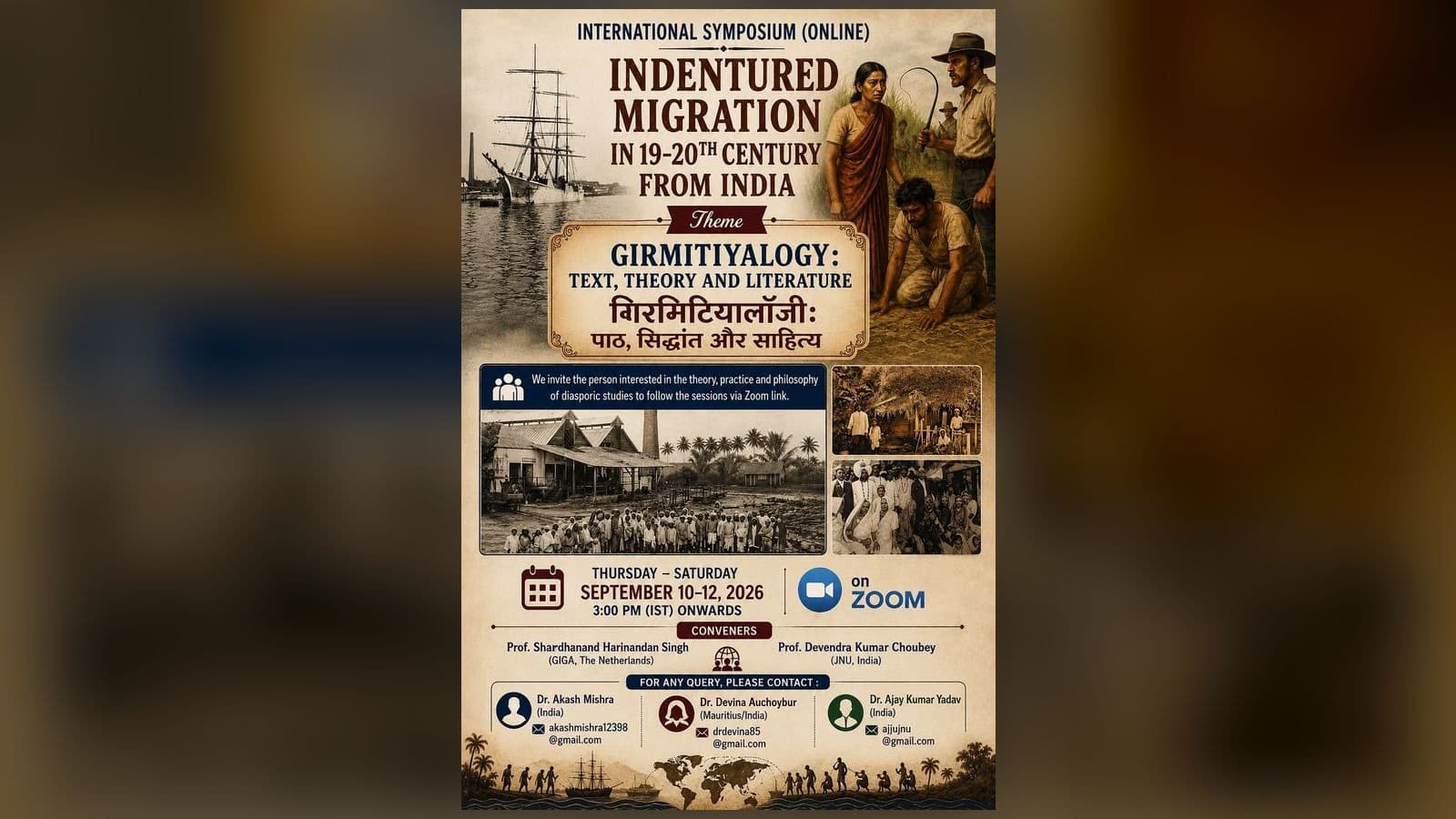
‘Girmitiyalogy’: an online symposium on India's indentured migration (10–12 September 2026)

The ship that was turned away: how Indians came to Canada