

The Diaspora Plate: how Trinidad turned chana bhatura into doubles
A north Indian street snack crossed the ocean with indentured labourers, lost its name, gained a new one, and became the unofficial national breakfast of Trinidad and Tobago.
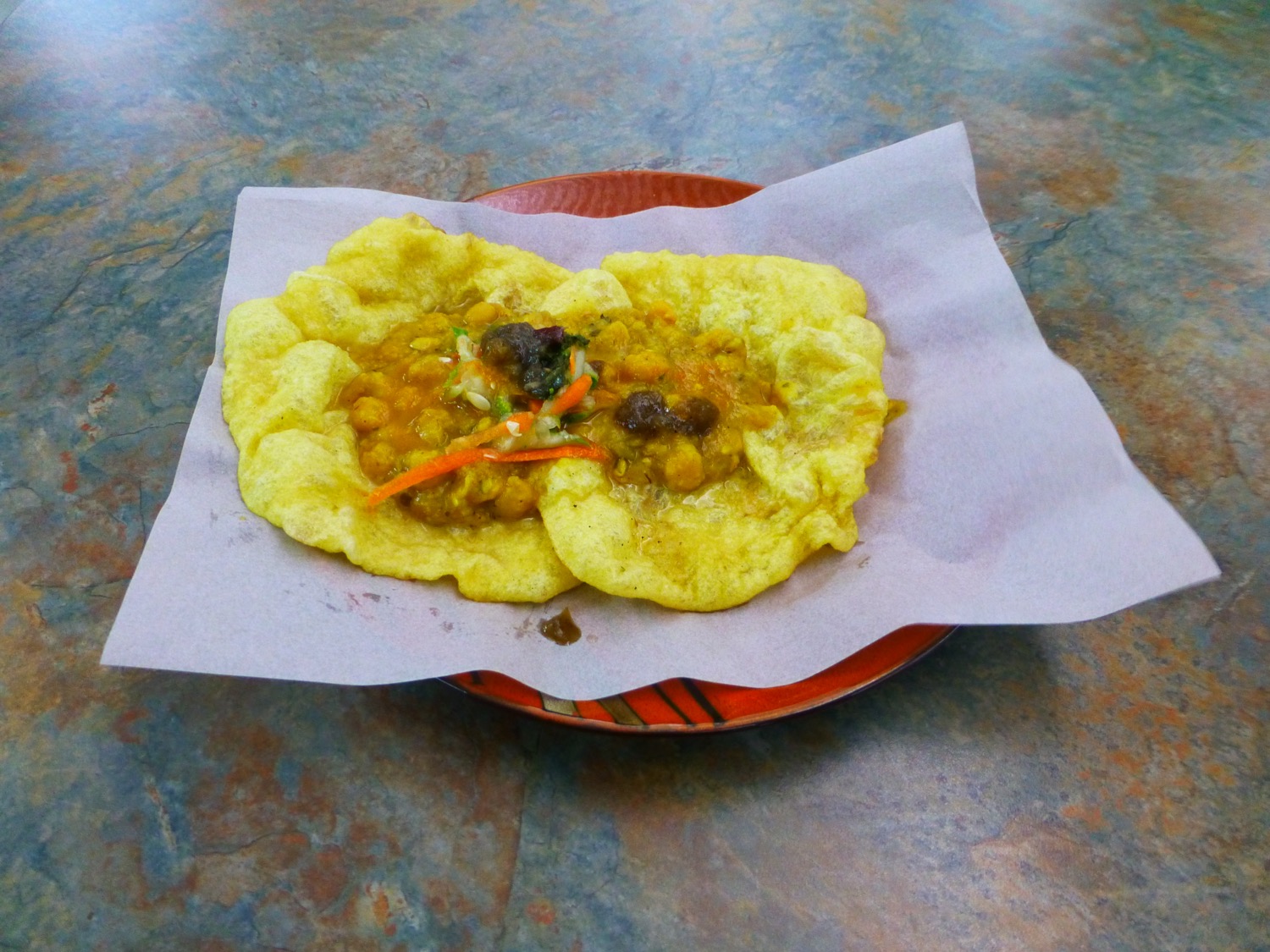
Every Trinidadian morning begins the same way for thousands of people: at a roadside cart, in a line that moves fast, asking the doubles man for "two, slight pepper." He flips two soft, turmeric-yellow flatbreads onto a square of waxed paper, heaps curried chickpeas between them, and dresses the lot with tamarind, cucumber and a fierce pepper sauce, folding the whole thing into a parcel you eat standing up. Doubles is the national breakfast of Trinidad and Tobago — and, like the people who created it, it is Indian and Trinidadian at once.
A food the indenture ships carried
The story begins with indenture. From 1845, Indian indentured labourers were brought to Trinidad to cut cane after the abolition of slavery, and they carried their kitchens with them — the flatbreads, the split peas, the chickpeas, the cumin and turmeric and chilli of the Gangetic plain. On the estates and in the villages that grew up after their contracts ended, that food survived, adapted and slowly seeped into the wider island palate.
The invention of doubles
Doubles itself has a surprisingly precise origin. It is traced to the 1930s and to an enterprising couple from Princes Town in south Trinidad, Emamool Deen and his wife Raheman Rasulan Deen, who sold curried chickpeas — channa — wrapped in a single fried flatbread called a bara, a snack they advertised simply as "channa and bara." Customers, finding one bara too messy and too small, began asking for a second to sandwich the filling. "Gimme a double," they would say — and the name, and the dish, were born.
What is actually in your hand
A doubles is deceptively simple and precisely balanced. Two pillowy baras — a soft, slightly sweet fried dough tinted gold with turmeric — cradle a scoop of tender, well-spiced curried channa. The magic is in the dressing: tamarind sauce for sourness, cucumber chutney for freshness, sweet mango kuchela, and a Scotch-bonnet pepper sauce so hot that ordering is a negotiation — "slight," "plenty," or the reckless "full pepper." Sweet, sour, spicy and soft, all in one cheap, hand-held parcel.
The dish behind the dish
To an Indian eye, doubles is instantly legible. Its clear ancestor is the North Indian street staple chole bhature — spiced chickpeas served with rounds of puffy fried bread — which the indentured labourers would have known at home. Doubles is what that dish became after a century on a Caribbean island: smaller, sweeter, drowned in tamarind and Scotch bonnet, sold from a cart rather than a dhaba. It is the same idea, re-grown in different soil.
The wider roti family
Doubles has a larger cousin: roti. The Indo-Trinidadian roti shop is its own institution, and the word covers a family of breads. Dhalpuri is a roti stuffed with seasoned ground split peas, rolled thin and used to wrap a curry of chicken, goat, duck, conch or pumpkin into a heavy, satisfying parcel. Paratha — known by the wonderful local name buss up shut, because the flaky, beaten bread looks like a "burst-up shirt" — is torn into shreds and eaten with curry on the side rather than wrapped around it. Sada roti is the plain everyday bread. Each is a direct descendant of the breads the labourers brought.
A genuinely national food
What makes doubles and roti remarkable is that they long ago stopped being "Indian" food in Trinidad and became simply Trinidadian food. The doubles cart is patronised by everyone, of every origin — Afro-Trinidadian, Indo-Trinidadian, Chinese, Syrian, dougla — at breakfast, after work, and especially in the small hours after a night out. It is the cheapest filling meal on the island and, for many, the most beloved. Few national dishes anywhere are so democratic.
A food that crossed the ocean again
And like the people, the food has migrated a second time. Wherever Indo-Trinidadians settled — in the "Little Caribbean" of Brooklyn, in Scarborough and Toronto, in London — the roti shop and the doubles cart followed. A Queens commuter can buy a dhalpuri roti or a doubles within sight of the subway, a food that travelled from Uttar Pradesh to a Trinidad cane village to a North American high street, picking up tamarind and Scotch bonnet along the way.
Indian, Trinidadian, and itself
Doubles is, in the end, a perfect edible portrait of the indenture diaspora. Its bones are unmistakably Indian; its flavour, its name, its street-corner culture and its place in the national heart are entirely Trinidadian. An Indian visitor would recognise the chickpeas and the fried bread and yet taste something they had never quite eaten before — which is exactly what happened to the people who made it, somewhere between the Ganges and the Caribbean Sea.
Continue the series · The Diaspora Plate
Related from Culture

The diaspora on your feed: the Indian-origin names to follow right now

From Merle Oberon to the red carpet: a century of Indian-origin women in the spotlight

Asmi Aderay, the Hyderabad-to-LA singer who refuses to pick one genre