

Bunny chow: how Durban's Indians turned a loaf of bread into a national dish
A hollowed-out loaf packed with curry, eaten by hand off a square of newspaper — Durban's bunny chow is South Africa's best-loved street food, and a dish whose history runs straight through indenture and apartheid.
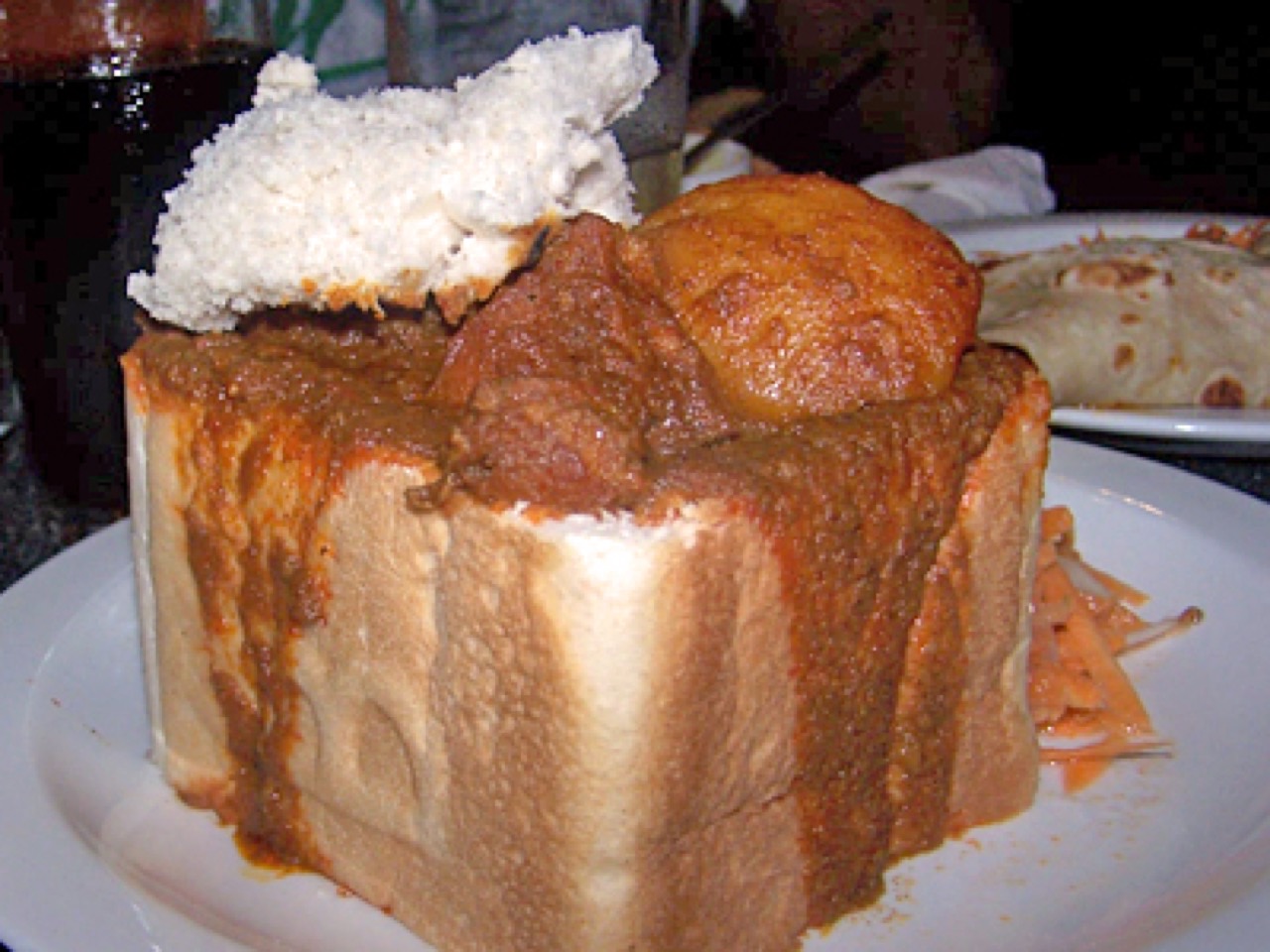
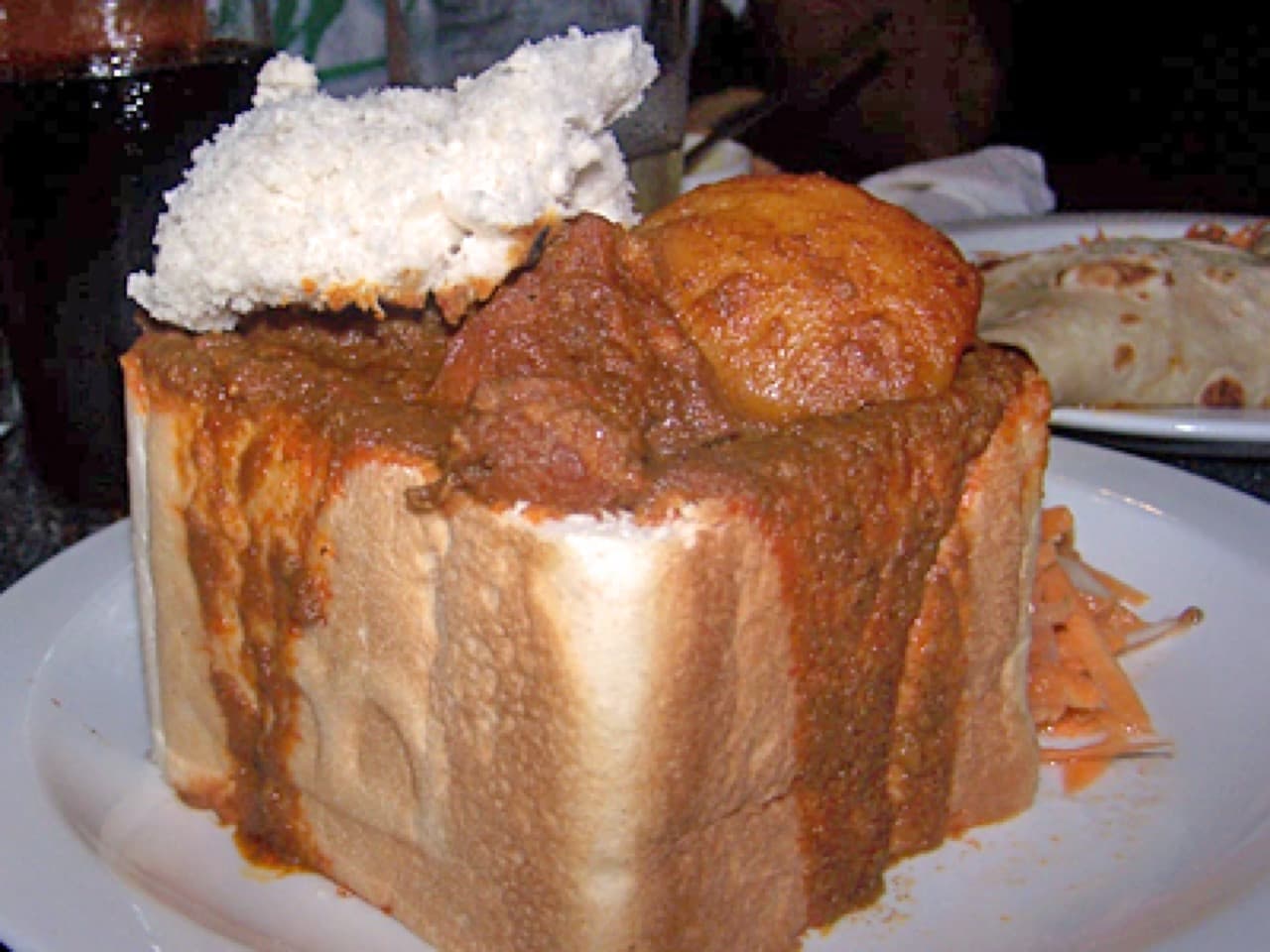
Order a bunny chow in Durban and you will be handed a thing that looks like a small architectural model: a quarter-loaf of white bread, its soft centre scooped out and the cavity filled to overflowing with curry, the torn-out lump of bread — the "virgin" — perched on top to seal it. There is no plate, no cutlery, no rabbit. You eat it with your hands, off a square of paper, standing up. It is the most beloved street food in South Africa, and one of the clearest cases anywhere of a diaspora inventing a dish that the whole country then claimed.
What it actually is
A bunny chow is exactly that: a hollowed loaf filled with curry. It comes in quarter, half and full sizes; the quarter is so standard that it has its own name, the kota ("quarter"). The fillings are Durban's own — mutton or lamb curry, chicken, beans, or sugar-beans-and-trotters — fierce, oily and deeply spiced, with a little grated-carrot sambal or salad on the side. It is cheap, filling and entirely portable, which is the whole point.
A Durban Indian invention
Bunny chow is the food of Durban's Indians — the largest community of Indian descent in Africa, built from the indentured labourers shipped to Natal's sugar estates from 1860 and the "passenger" Gujarati traders who followed. Durban is sometimes called the biggest Indian city outside India, and the bunny is its signature. The dish is generally dated to the 1940s, though, as with most great street foods, its precise birth is disputed.
Three origin stories
The competing tales all point in the same direction. One credits Indian golf caddies who, unable to leave the course to reach the cafes of Durban's Grey Street, had curry brought to them packed in bread. Another traces it to indentured cane workers who needed a way to carry a hot curry into the fields without a plate, and hollowed a loaf to do it. The most pointed story is about apartheid itself: with laws barring Black and Indian customers from sitting inside white cafes, takeaway curry was sold from side hatches and back doors — and bread, needing no crockery to return, was the perfect vessel.
The name has nothing to do with rabbits
The word "bunny" is the giveaway that this is an Indian dish. It is a corruption of bania — the term for the Gujarati merchant-trader caste who ran many of the cafes and sold the curries. Bania chow became "bunny chow," and a generation of visitors has assumed, wrongly, that there was once rabbit in it.
Apartheid, served in a loaf
It is hard to think of a national dish more bound up with segregation. The bunny chow was shaped by people who were forbidden to sit down and eat where they liked — a portable meal for a population kept moving, kept outside, kept at the back door. That history sits inside the comfort food: a dish born of exclusion that became, after apartheid fell, a point of shared national pride.
From the back door to the icon
Today the bunny is everywhere in South Africa, the star of festivals and food guides, sold from humble Durban institutions and gentrified into gastropub versions in Johannesburg and Cape Town. Its township cousin, the Soweto kota — a hollowed loaf stuffed with chips, polony and sauce — is the same idea, mutated. The diaspora that invented the bunny has carried it further still, to Indian-South-African communities in London and Toronto.
The diaspora plate
Bunny chow belongs on the same shelf as Britain's chicken tikka masala and Trinidad's doubles: an Indian-rooted dish that became wholly something else abroad. Its spices came from Tamil Nadu and Gujarat by way of the indenture ships; its form — bread as bowl — was invented in Natal, for Natal's particular cruelties and conveniences. You cannot eat a bunny chow without, in some small way, eating South African history.
Continue the series · The Diaspora Plate
Related from Culture

The diaspora on your feed: the Indian-origin names to follow right now

From Merle Oberon to the red carpet: a century of Indian-origin women in the spotlight

Asmi Aderay, the Hyderabad-to-LA singer who refuses to pick one genre