


BAPS Abu Dhabi: the first hand-carved Hindu temple in the Gulf
Part 6 of Temples of the Diaspora. On 14 February 2024, a pink-sandstone-and-marble mandir rose from the desert outside Abu Dhabi - the first traditional hand-carved Hindu temple in the Gulf, built on land the UAE's ruler gifted, and now the largest in West Asia. It is a diaspora announcing its permanence in the unlikeliest of places.
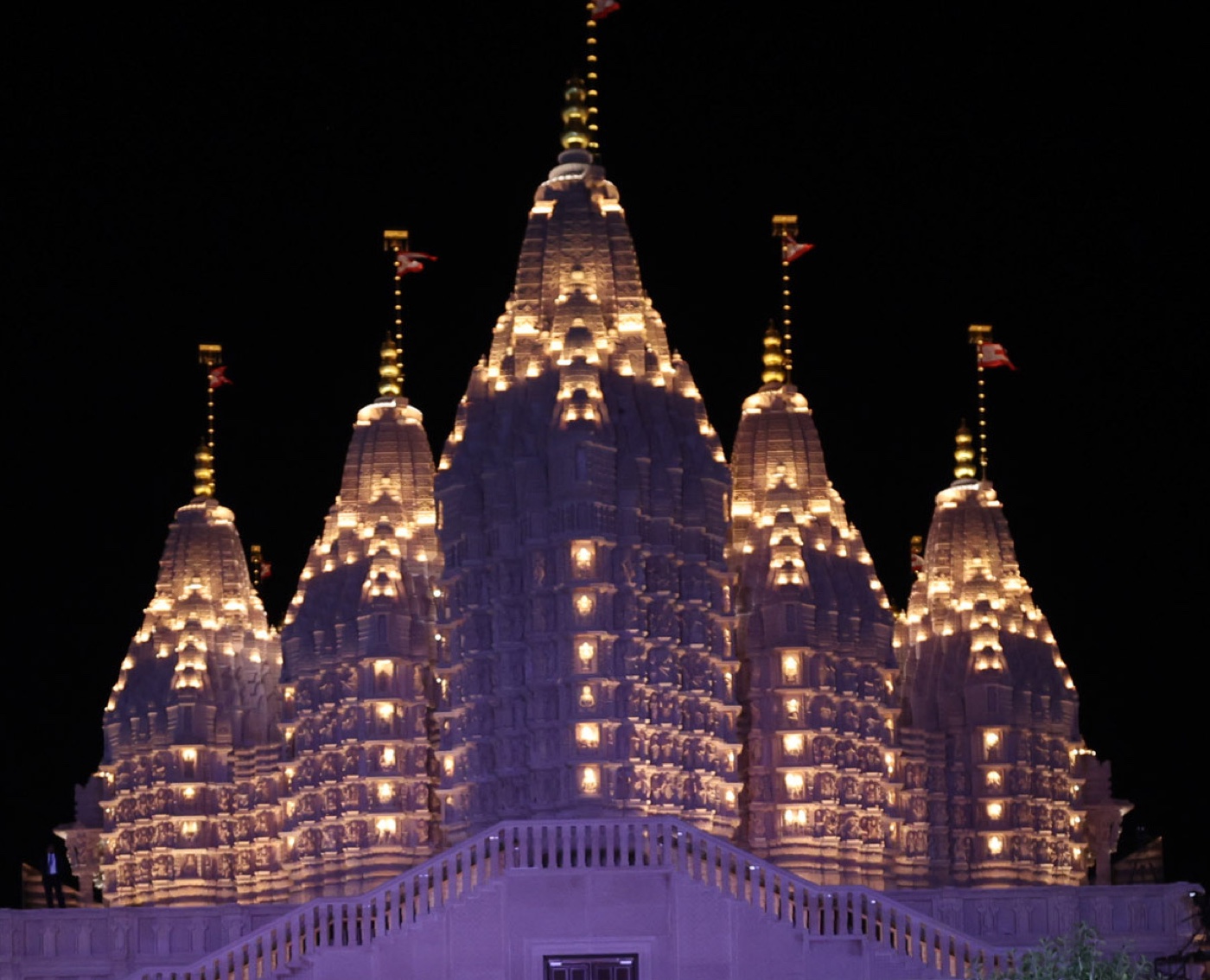
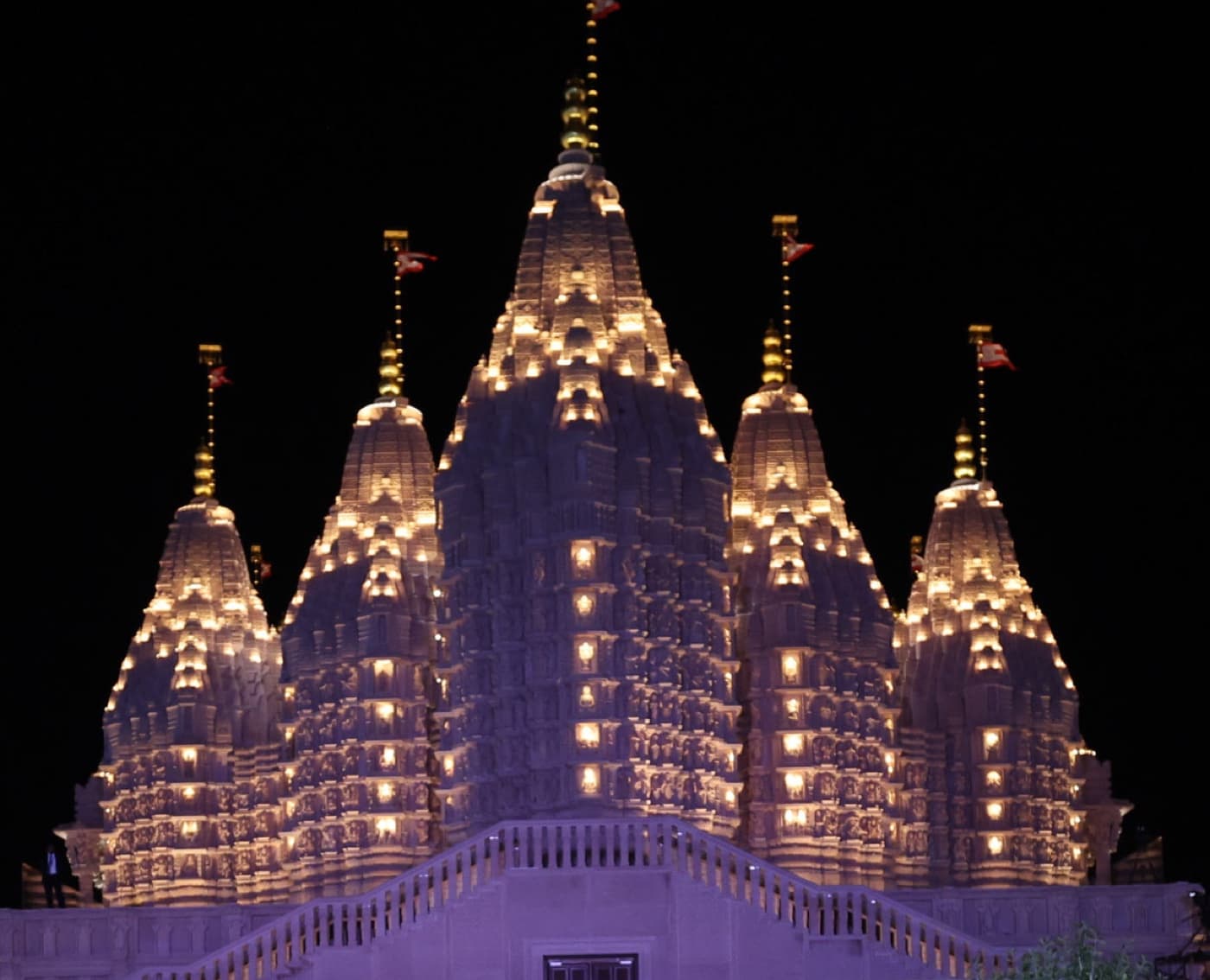
The temples a diaspora builds abroad are arguments in stone: that it is here to stay, and confident enough to make something monumental. Nowhere is that argument more surprising than in the desert west of Abu Dhabi, where a mandir of pink sandstone and white marble now stands in a Muslim-majority Gulf state that had never before permitted a traditional Hindu temple.
The BAPS Hindu Mandir Abu Dhabi was consecrated on 14 February 2024 by Mahant Swami Maharaj, the spiritual head of the BAPS Swaminarayan Sanstha, alongside India's Prime Minister Narendra Modi. It is the first traditional, hand-carved stone Hindu mandir in the UAE, and the largest in West Asia. When it opened to the public on 1 March 2024, the response answered any doubt about whether it was needed: on the first public Sunday, more than 65,000 people came.
Land granted, not merely permitted
What makes the mandir extraordinary is not only that it exists, but how it came to. The plot - some 5.4 hectares in Abu Mureikhah, off the Dubai-Abu Dhabi highway - was granted in 2015 by the UAE's leadership, a gift of land from a Gulf ruler to a Hindu institution. For the roughly three-and-a-half million Indians who live and work in the UAE - the country's largest expatriate community - it was an act of recognition as much as real estate: a permanent, monumental home for a faith that had until then worshipped in converted villas and community halls.
The idea was old. Pramukh Swami Maharaj, the BAPS leader before Mahant Swami, is said to have envisioned a mandir in Abu Dhabi as far back as 1997. The first stone was consecrated in 2018, the foundation laid in 2019, and construction began that December. What rose over the next four years was not a modern building dressed in traditional motifs but a genuine hand-carved stone temple, made the old way.
Carved by hand, assembled in the sand
The mandir is built from pink sandstone from Rajasthan and white Italian marble, hand-carved by artisans in India and shipped to the Emirates to be assembled - the same painstaking method BAPS used for its temples in Neasden and New Jersey. Tens of thousands of carved stone pieces, each numbered, fit together on site like a devotional jigsaw the size of a stadium.
Its architecture carries a deliberate message. The mandir has seven spires, one for each of the seven emirates of the UAE, and each spire houses a deity drawn from a different Indian tradition - a design that folds the host nation and the guest faith into a single silhouette. Sensors embedded in the structure monitor temperature and seismic activity, marrying millennia-old craft to Gulf engineering.
A temple that tries to speak to everyone
The most striking choice is on the exterior walls. Rather than confining the carvings to Hindu epics, the mandir's outer surfaces depict stories from civilisations across human history - African, Arabian, Aztec, Egyptian, Mayan, Mesopotamian, Native American and Indian among them. Two of the world's great rivers of story, the Ganga and the Yamuna, are represented in flowing water features running through the site.
The universalism is not accidental. A Hindu temple in the Gulf is, inevitably, a statement about coexistence, and BAPS built one that reaches past its own congregation. It has become a point of pilgrimage for the diaspora and a point of curiosity for everyone else: in its first two years the mandir welcomed around four million visitors, many of them not Hindu at all.
What it means for the Gulf diaspora
To understand why a temple matters so much here, remember what Gulf residence is. It is tied to a job and a visa, not a path to citizenship; most of the millions of Indians in the UAE are, in the legal sense, always temporary. They build the cities, send home a fifth of all the remittances India receives, and raise children who have never lived in India - and yet, for decades, they had no permanent, public, monumental place to be Hindu.
The mandir changes that calculus. A diaspora that worships in a hand-carved stone temple on land gifted by the state is no longer quite so temporary, whatever the visa says. That is the through-line of this series: from Akshardham in New Jersey to Batu Caves in Malaysia, the great diaspora temples are the moment a community stops apologising for its presence and builds something that will outlast every one of its founders. Abu Dhabi's is the newest, and in some ways the boldest - because it was built where the smart money said it could never be built at all, and because the desert made room for it.
The diplomacy in the stone
A temple of this scale in the Gulf is never only a religious building. That India's Prime Minister flew in to co-inaugurate it, standing beside the BAPS spiritual head before a crowd drawn from more than 30 countries, made the point plainly: the mandir is a marker of the India-UAE relationship, which also runs through booming trade, energy, and the remittance billions the Emirates' Indian workforce sends home each year. For the UAE, which has spent years positioning itself as the Gulf's pluralist hub, granting the land was a statement of its own - proof, cut in Rajasthani sandstone, of the tolerance it markets to the world.
That is the paradox worth sitting with. The Indians who worship here mostly cannot become Emirati citizens; their belonging is provisional by law. And yet their faith now has a more permanent, more monumental home in Abu Dhabi than it does in many Indian cities. The temple does not resolve that contradiction so much as embody it - a diaspora that is officially temporary, worshipping in something built to stand for centuries.
The seven spires catch the Gulf sun each morning now, one for each emirate, and the queues form again. For a community that arrived to work and expected to leave, that is a kind of homecoming that no exit visa can undo.
Continue the series · Temples of the Diaspora