

Batu Caves: the Tamil temple inside a Malaysian mountain
A 140-foot golden statue of Murugan, 272 rainbow-painted steps, and a Hindu temple set inside a 400-million-year-old limestone cave outside Kuala Lumpur — Batu Caves is the spiritual capital of Malaysia's Tamil community, and the site of the largest Thaipusam festival on Earth.
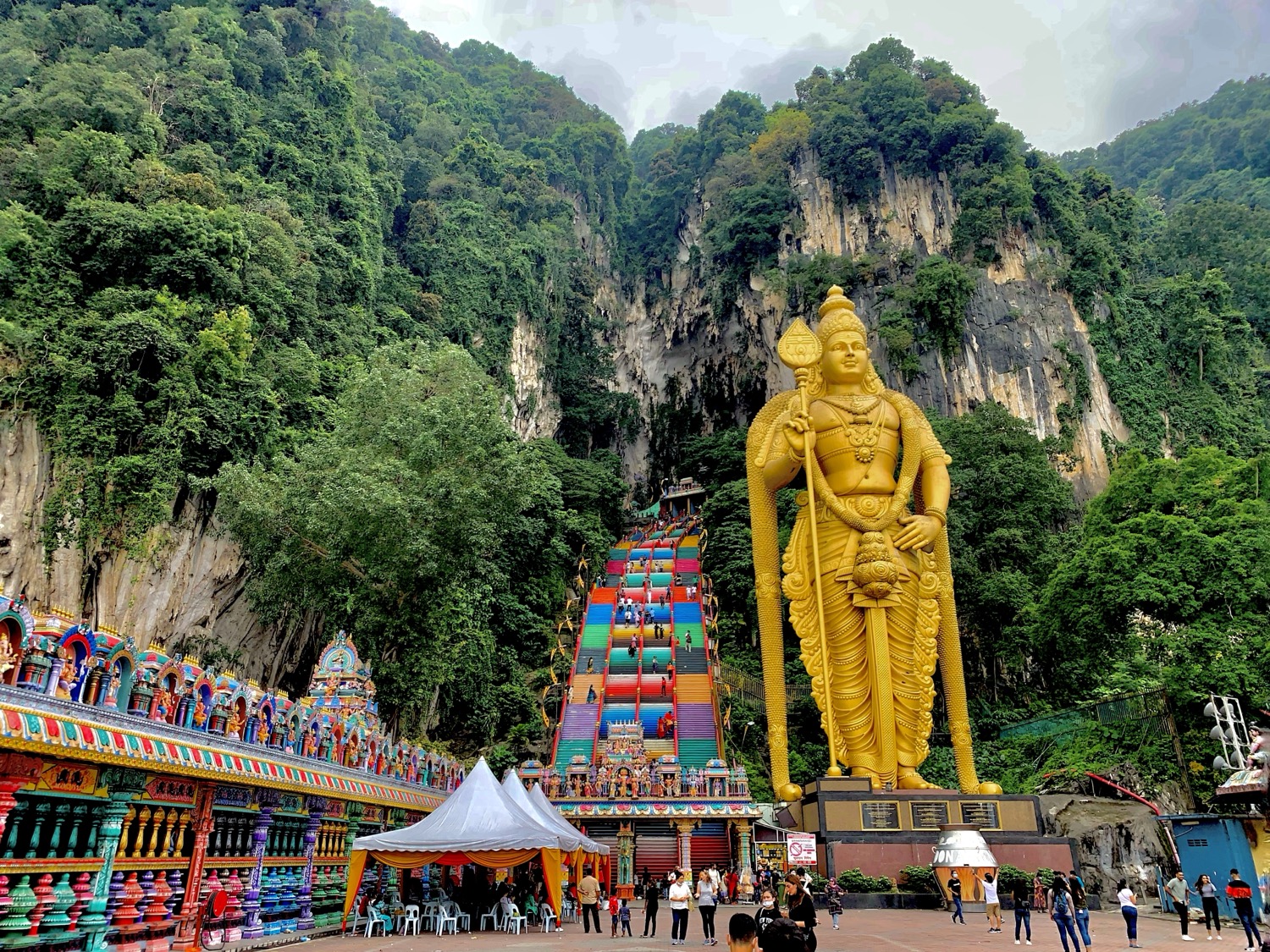
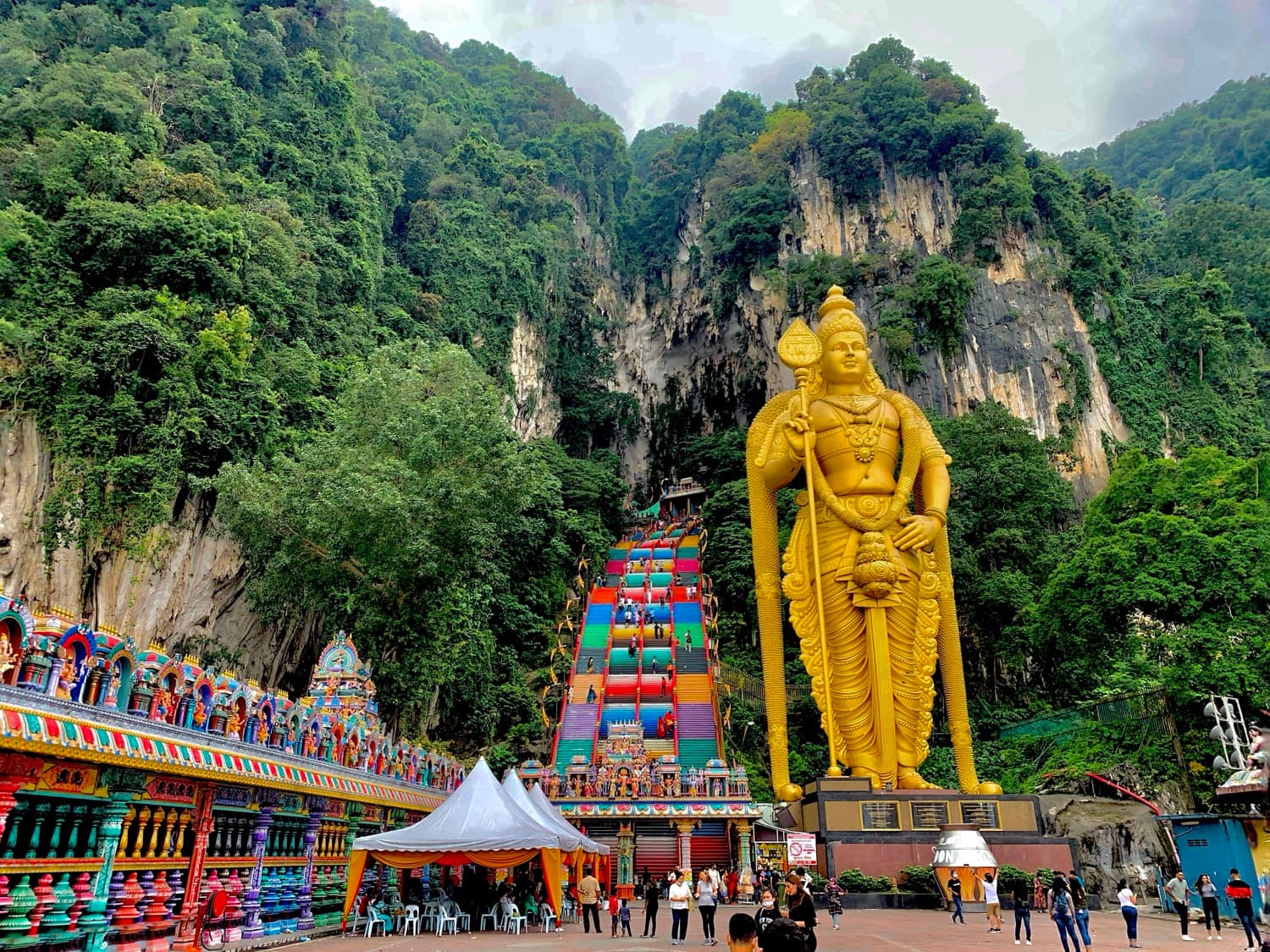
Rising from the plain about thirteen kilometres north of Kuala Lumpur is a great limestone crag, and at its foot stands a golden colossus: a 42.7-metre statue of the Hindu god Murugan, 140 feet of gilded warrior, the tallest statue in Malaysia and the second-tallest Murugan anywhere in the world. Behind him, 272 brightly painted steps climb into the mouth of a cave hollowed out of 400-million-year-old rock, where a Hindu temple has stood for more than a century. This is Batu Caves — the spiritual heart of Tamil Malaysia, and one of the most spectacular Hindu sites outside India.
A mountain older than the gods
The caves themselves are a wonder of deep time. They riddle a limestone mogote — an isolated steep-sided hill — formed more than 400 million years ago, long before any human faith. For most of that history they were home only to bats and swiftlets. Their transformation into a temple is a story of the nineteenth-century Indian diaspora.
The trader who saw a shrine
In the 1890s an Indian Tamil trader named K. Thamboosamy Pillai, a leader of Kuala Lumpur's growing Indian community, looked at the cave's soaring main chamber and saw a natural temple. He promoted it as a site of worship for Murugan — the Tamil warrior-god especially beloved in the south Indian devotional tradition — and a shrine was completed in 1891. The following year, 1892, the first Thaipusam celebration was held there, beginning a tradition that would grow into the largest of its kind on the planet.
The 272 steps
For its first decades the temple could be reached only by scrambling up the hillside. Wooden steps were installed in 1920, and when those rotted, 272 concrete steps were built in 1940, following a proposal by a community figure named Ramachandra Naidu. Those steps — repainted in a riot of rainbow colours in 2018, a makeover that made Batu Caves an Instagram sensation and briefly stirred controversy with heritage authorities — are now as iconic as the cave itself, patrolled by bands of long-tailed macaques who relieve pilgrims of their snacks.
The golden god
The statue that anchors the whole site is younger than most visitors assume. The vast golden Murugan was unveiled on 29 January 2006, after three years of work by craftsmen who covered its concrete-and-steel frame in gold paint. At nearly 43 metres it dwarfs the pilgrims at its feet and has become the defining image of Hindu Malaysia, reproduced on postcards, travel posters and the covers of guidebooks worldwide.
Thaipusam
Once a year the site transforms utterly. At Thaipusam, the festival honouring Murugan, Batu Caves becomes the stage for one of the most intense acts of devotion in the Hindu world. Devotees fulfil vows by carrying kavadi — ornate frames borne on the shoulders — and many pierce their skin, tongues and cheeks with hooks and skewers, entering trance states as they climb the 272 steps in a river of humanity. The Batu Caves Thaipusam is the largest observance of the festival outside India, drawing between 1.2 and 2.5 million devotees and spectators over its days — a colossal, cathartic display of faith in a Muslim-majority country.
The community it belongs to
Batu Caves is the temple of Malaysia's Indians — a community overwhelmingly Tamil in origin, descended largely from the labourers brought by the British from south India in the nineteenth and early twentieth centuries to work the rubber estates and build the railways. Hindus are a minority in Muslim-majority Malaysia, and their relationship with the state has at times been strained, with disputes over temple demolitions and religious freedom. Against that backdrop, Batu Caves stands as an unmissable, mountain-sized assertion of Tamil Hindu presence and permanence — a place the community can point to and say, without qualification, that it belongs.
Why the series remembers it
Temples of the Diaspora has visited the hand-carved marble mandirs of New Jersey and London — deliberate, expensive statements of arrival. Batu Caves is something different and older: not built but discovered, a natural cathedral that a Tamil trader consecrated a hundred and thirty years ago and that generations of estate workers and their descendants have made the beating heart of their faith. Where the newer temples announce that the diaspora has arrived, Batu Caves announces that it has endured — carved into a mountain older than humanity, climbed each year by millions, and crowned by a golden god who can be seen for miles across the Malaysian plain.
Faith under pressure
Batu Caves is more than a temple; it has been a rallying point. In 2007 it became the gathering place for a mass demonstration by the Hindu Rights Action Force, a landmark moment in the Malaysian Indian community's campaign for equal treatment, and the site has repeatedly stood at the centre of debates over the rights of a Hindu minority in a Muslim-majority state where temple demolitions and religious-freedom disputes recur. For Malaysia's Tamils, the golden god on the hill is not only a place of worship but a symbol of a community's claim to belong.
Between pilgrimage and Instagram
The 2018 repainting of the 272 steps in rainbow colours — done without the approval of heritage authorities, and briefly the subject of an official dispute — captured the site's double life. Batu Caves is at once one of the holiest Hindu sites in Southeast Asia and one of Kuala Lumpur's most-visited tourist attractions, its steps thronged daily by pilgrims climbing to pray and travellers climbing for a photograph, its macaques and its market stalls and its towering statue all folded into the same spectacle. That the sacred and the touristic coexist there so completely is itself part of what makes it a temple of the diaspora — visible, photographed, unmissable, and still, for millions, profoundly holy. The complex is really a set of caverns, each with its own character. The vast main chamber — the Temple Cave, or Cathedral Cave — soars nearly a hundred metres overhead, open to the sky through a gap in the rock, so that shafts of daylight fall on the shrines below. Lower down, the Ramayana Cave stages the epic in brightly painted tableaux, and the Dark Cave, long closed to protect a delicate ecosystem of rare spiders and bats, preserves the mountain's wild interior. To climb the 272 steps and pass from the glare of the Malaysian sun into that cool, cathedral-like dark is the heart of the pilgrimage.
Continue the series · Temples of the Diaspora
Related from Culture

The diaspora on your feed: the Indian-origin names to follow right now

From Merle Oberon to the red carpet: a century of Indian-origin women in the spotlight

Asmi Aderay, the Hyderabad-to-LA singer who refuses to pick one genre