

Suriname: the Lalla Rookh and the Hindustanis of the Dutch Caribbean
The Dutch took Indian indentured labourers too. Their descendants — the Hindustanis — are the largest community in Suriname, and a sizeable diaspora in the Netherlands.
Indian indenture was not only a British story, and not only a Caribbean one. On 5 June 1873 the Lalla Rookh reached Paramaribo, the capital of Dutch Suriname, carrying 410 Indian indentured labourers from Calcutta — the first of tens of thousands the Netherlands would bring to its sugar colony on the north-eastern shoulder of South America.
A colony rented from the British
It happened by treaty. In 1870 the Dutch signed an agreement with Britain allowing them to recruit from British India, and recruitment began in 1873 — a decade after the Netherlands had abolished slavery in Suriname and needed new hands for the cane. Between 1873 and 1916, around 34,000 indentured labourers were shipped in, drawn from the same heartland as every other crossing: the districts of present-day Uttar Pradesh, Bihar and Jharkhand. They came under the familiar five-year bond, to the familiar barracks and the familiar cane, working under conditions the records describe as stringent and frequently exploitative.
The man and woman who landed first
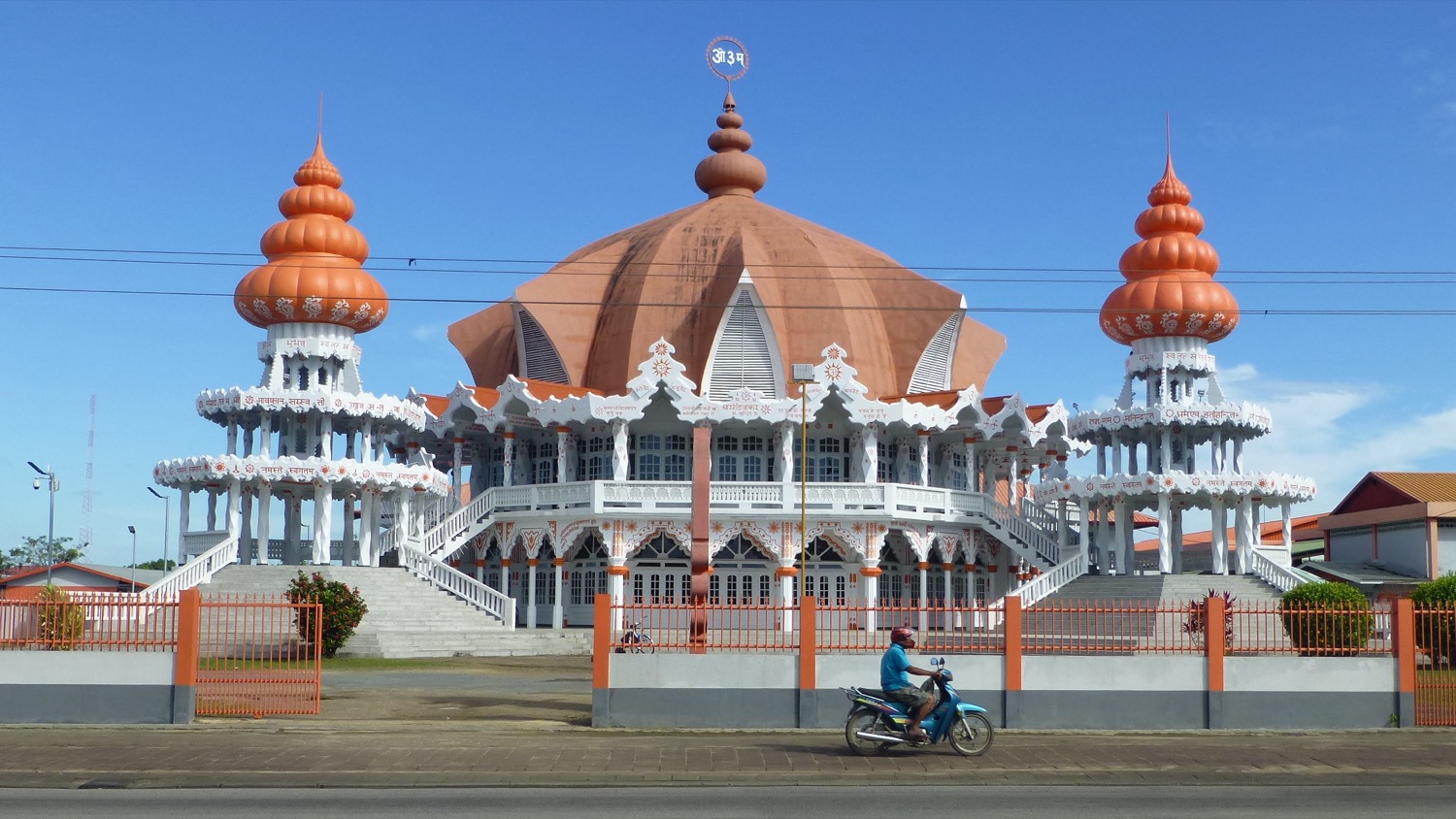
Surinamese Hindustanis remember their origin in a single monument. In Paramaribo stands the Baba en Mai — "Father and Mother" — a memorial to the first Indian man and woman to set foot on Surinamese soil, a quiet acknowledgement that an entire people descends from those who survived the Lalla Rookh and the ships that followed.
A language of their own
What the labourers built, more durably than anything, was a language. Sarnami Hindustani is an Indo-Aryan koiné that fused the Bhojpuri and Awadhi of the indentured majority with elements of standard Hindi-Urdu — a new tongue, born in the cane lines of Nickerie and Saramacca, that exists nowhere else on earth. It is one of the great survivals of the indentured diaspora: not Indian, not Dutch, but Surinamese-Indian, spoken at home long after the plantations closed.
A people in politics
Unlike the indentured of some other colonies, Suriname's Hindustanis built durable political power. In 1949 the lawyer Jagernath Lachmon helped found the Progressive Reform Party (the VHP), which became the political home of the Hindustani community and a defender of its interests against the Creole majority. Wary of being marginalised, Lachmon's party opposed a hasty rush to independence — and its caution proved prescient. The community's political arrival reached its summit in 2020, when Chandrikapersad "Chan" Santokhi, a former police chief of Indian descent, became President of Suriname, an heir of the Lalla Rookh in the highest office in the land.
The twice-migrated people
Suriname's Hindustanis are now the largest single community in the country, more than a quarter of the population. But their most distinctive feature is a second migration. As Suriname approached independence from the Netherlands in 1975, a large share of the community — fearing instability in the new state — moved again, to the former colonial metropole. Mass migration in the mid-1970s, continuing through the military rule of the 1980s and the hard 1990s, carried some 350,000 people of Surinamese descent to the Netherlands. Today there are large Surinamese-Hindustani communities in The Hague and Amsterdam — Hindu temples and roti shops in Dutch suburbs — an Indian diaspora that reached Europe by way of a plantation in South America, two migrations removed from the village it started in.
The diaspora Europe forgot
It is, in a sense, the Indian diaspora that Europe almost overlooked: an Indo-Aryan-speaking, Hindu-and-Muslim community of Dutch citizens whose great-grandparents cut cane in a colony most Europeans could not place on a map. Their journey — from the Gangetic plain, to a Dutch sugar estate, to a terraced street in The Hague, and to the presidential palace in Paramaribo — is one of the most travelled in the entire indentured world, and one of the least told.
Related: the Girmitiya diaspora — the descendants of indenture who built new nations across the old plantation world.
Continue the series · Children of the Girmit
Related from Heritage
‘Girmitiyalogy’: an online symposium on India's indentured migration (10–12 September 2026)
The ship that was turned away: how Indians came to Canada
From the mills to Downing Street: how South Asians made Britain home