

Noor Inayat Khan: the princess, the wireless set, and the word she took to Dachau
She was the great-great-granddaughter of Tipu Sultan and a children's author raised to non-violence — and Britain's first female wireless operator in occupied Paris. The forgotten story of SOE agent 'Madeleine', executed at Dachau.
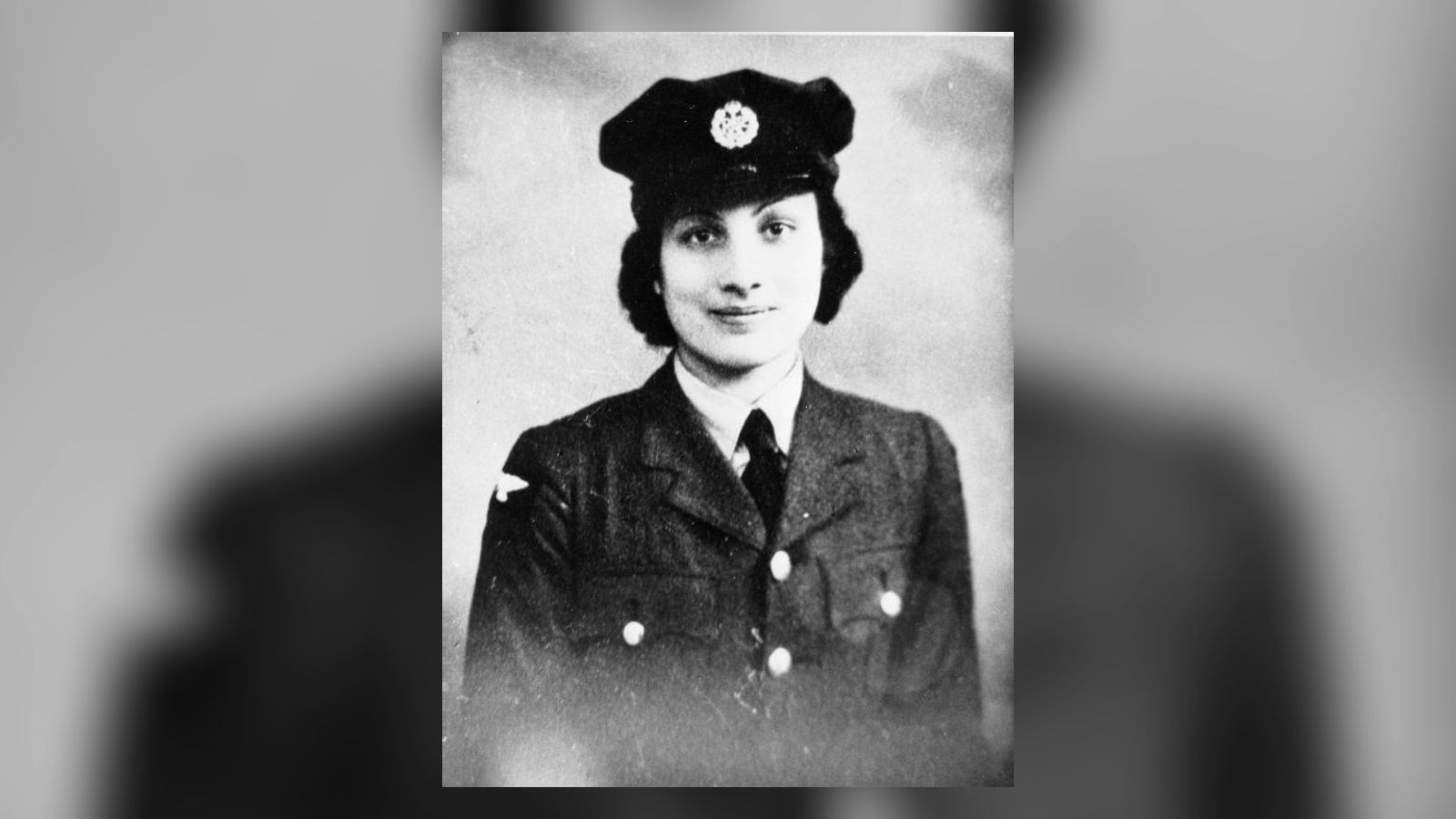
For a few desperate months in 1943, the entire wireless link between the French Resistance in Paris and its masters in London ran through one woman and one suitcase radio. Her network had collapsed around her, its agents swept up by the Gestapo; London told her to come home, and she refused, because leaving would have cut the last line out of the occupied capital. She moved from flat to flat with the set that could get her killed, tapping out messages the Germans were frantically trying to trace. Her name was Noor Inayat Khan. She was the great-great-granddaughter of Tipu Sultan, the ruler of Mysore, and she would die at Dachau with the word liberté on her lips.
Hers is one of the strangest and most moving stories the Indian diaspora has to offer, and it is barely told. A princess by descent, a pacifist by upbringing, a children's author by vocation, she became one of Britain's bravest secret agents of the Second World War — and then, for decades, a near-forgotten one.
A Sufi household, from Moscow to Paris
Noor-un-Nisa Inayat Khan was born in Moscow on 1 January 1914. Her father, Inayat Khan, was an Indian musician and teacher who carried the Sufi tradition to the West; his own great-great-grandfather was Tipu Sultan, the "Tiger of Mysore" who died fighting the British in 1799. Her mother, born Ora Ray Baker in Albuquerque, New Mexico, was American, and took the name Pirani Ameena Begum. It was a household built on music, tolerance and non-violence — about as far from the world of sabotage and cyanide pills as a childhood could be.
War scattered that world. The family left Moscow for London in 1914, then settled in 1920 at Suresnes, just outside Paris, where Noor grew up bilingual and gentle, studying child psychology and music. In 1939 a London publisher brought out her children's book, Twenty Jataka Tales, retellings of the Buddhist fables about self-sacrifice and compassion. Within a year she would be fleeing the German advance, and within four she would be dead.
'Madeleine'
When France fell in 1940, the family escaped to England. Noor, who might easily have sat out the war, joined the Women's Auxiliary Air Force and trained as a wireless operator. Her fluent French and her radio skills drew the attention of the Special Operations Executive, the secret service Winston Churchill had founded to "set Europe ablaze" — to run sabotage and resistance behind enemy lines. That a quiet, idealistic woman raised to abhor violence should volunteer for the most dangerous clandestine work going is one of the puzzles her biographers have never quite resolved. She volunteered anyway.
In June 1943 she was flown into occupied France, the first female wireless operator Britain had ever sent into the field. Her codename was Madeleine. Wireless operators had the shortest life expectancy of any agent — the Germans had direction-finding vans that could triangulate a transmitter in minutes — and within weeks of her arrival the Paris network she had joined, PROSPER, was rolled up in a wave of arrests. London offered to extract her. She stayed, and for the next several months was the only British wireless link operating in the Paris region, doing the work of a whole network alone, constantly moving, constantly transmitting, one step ahead of the men hunting her signal.
Pforzheim, and the silence
She was betrayed, not caught by chance. In October 1943 — on or around the 13th — she was arrested and taken to the Gestapo's Paris headquarters; the betrayal has long been attributed to a Frenchwoman, Renée Garry, said to have been paid for the information. The Germans had her, and they had her notebooks. What they could not get was her cooperation.
Noor gave them nothing. She tried to escape, twice. Classed as highly dangerous, she was shipped to the prison at Pforzheim in Germany and held in solitary confinement, shackled hand and foot, for months, interrogated and mistreated and still refusing to talk. On 12 September 1944 she and three other captured women agents were moved to the Dachau concentration camp. At dawn the next morning they were shot. By the most widely repeated account, her last word was Liberté.
She was thirty.
The long forgetting, and the slow return
For a long time Britain did not know what to do with her memory. The secret world she had died in was, by definition, secret; her Indian descent and Muslim faith fit awkwardly into the war's remembered cast. Recognition came, but posthumously and in pieces. France awarded her the Croix de Guerre with gold star in 1946. In 1949 Britain gave her its George Cross, the highest civilian award for gallantry, "for conspicuous courage, both moral and physical" — one of only three awarded to women of the SOE.
The fuller return took another half-century. In 2012 a bronze bust of Noor was unveiled in Gordon Square Gardens in Bloomsbury, a short walk from the house the family had lived in on arriving in London — the first free-standing memorial in Britain to a woman of Asian origin, and to a Muslim. In 2014 the Royal Mail put her face on a stamp. A woman the war had tried hard to erase now has a monument in central London and a place, at last, in the national story.
Where she belongs
Noor Inayat Khan sits on a particular and under-populated shelf of history: Indians who did extraordinary things abroad, for strangers and for causes larger than themselves, and whose stories the diaspora has been slow to claim. It is the same shelf that holds Kundanlal Gupta, the Ludhiana trader who forged visas to pull Jewish families out of Nazi Vienna — ordinary and extraordinary people who, a long way from India, decided that someone else's freedom was worth their own safety.
Her life also belongs to the longer history of how Indians came to Europe and made it home — the musicians and students and exiles who, generations before the great post-war migration to Britain, were already woven into the continent's life. Most of them are remembered, if at all, for how they lived. Noor Inayat Khan is remembered for how she died: a descendant of a Mysore king, raised to gentleness in a Sufi household near Paris, who kept a city's secrets through months of torture and carried one word to a concentration-camp wall. Liberté.
Sources: biographical and service detail per the Noor Inayat Khan entry on English Wikipedia (drawing on SOE records), English Heritage, Britannica and The Gazette's history of the SOE; the Croix de Guerre (1946) and George Cross (1949) citations; the Gordon Square bust (unveiled 8 November 2012) and the Royal Mail stamp (25 March 2014). Photo credit below.
Related from Heritage
Kundanlal Gupta: the Indian who saved Jewish families from the Nazis
The Lunatic Line: the Indians who built East Africa's railway
‘Girmitiyalogy’: an online symposium on India's indentured migration (10–12 September 2026)