

Swami Prabhupada: bhakti in a New York storefront
Part 6 of The Masters Who Crossed the Ocean. He arrived in New York in 1965 at sixty-nine, with seven dollars and a trunk of his own books — and within a decade had founded a worldwide religion.
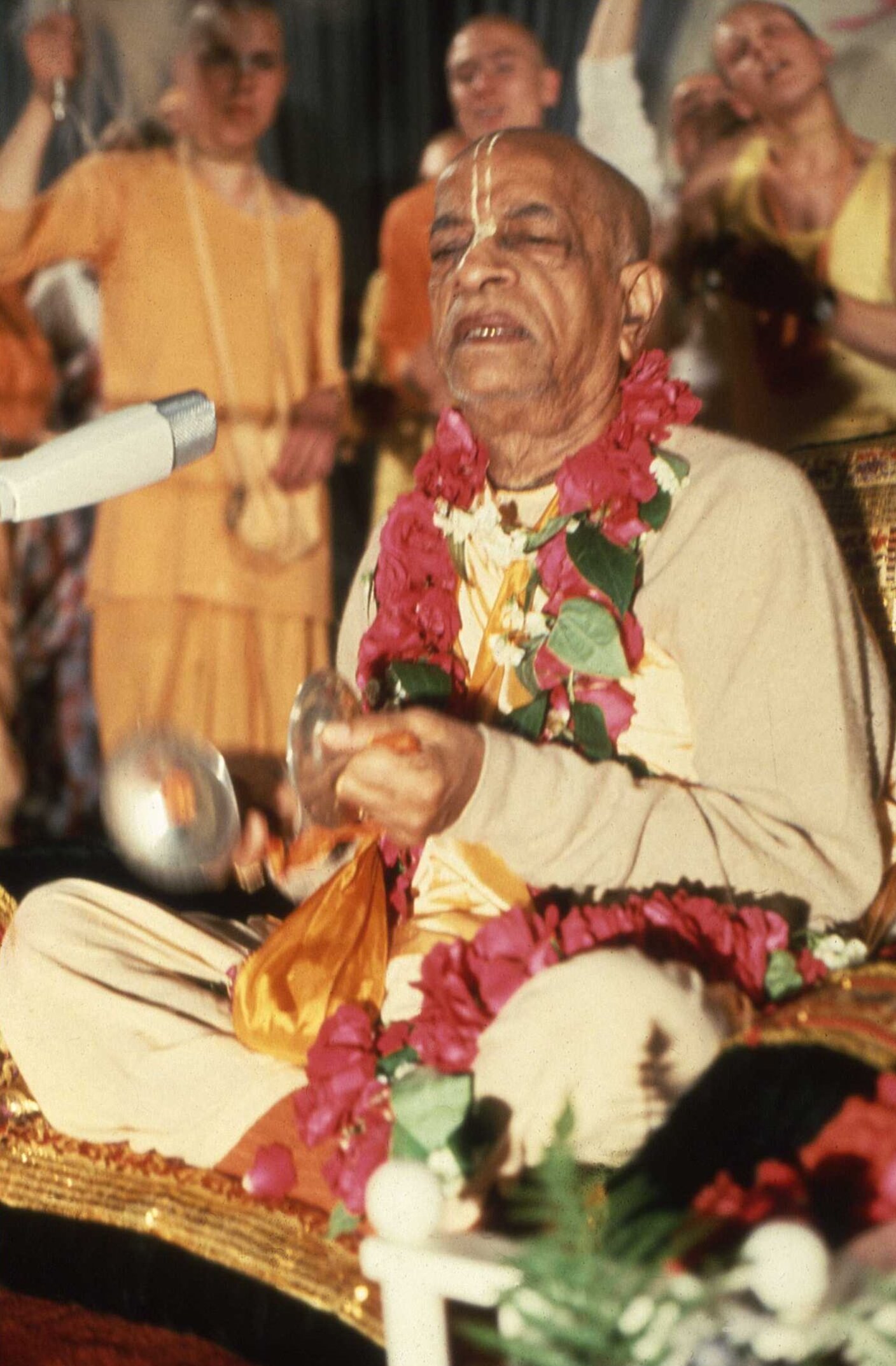
In August 1965 a 69-year-old Indian monk boarded a creaking cargo steamer in Calcutta carrying almost nothing: a suitcase, an umbrella, a tin of dry cereal, about forty rupees — roughly seven US dollars — and crates of his own translations of a Sanskrit scripture. He suffered two heart attacks on the voyage. By any reasonable measure he was the least likely founder of a global religious movement in modern history. Within a decade A. C. Bhaktivedanta Swami Prabhupada had planted Krishna devotion on every inhabited continent.
A long apprenticeship
He was born Abhay Charan De in Calcutta in 1896. In 1922 he met his spiritual master, Bhaktisiddhanta Sarasvati, who gave him an instruction that would define his life: to spread the teachings of Krishna-bhakti in the English language, to the Western world. For decades Abhay lived an ordinary householder's life — a pharmaceutical businessman, a husband and father — while slowly preparing. Only in 1959, his family responsibilities behind him, did he take the renounced order of sannyasa and begin in earnest his translation of the vast Srimad-Bhagavatam.
The Jaladuta
In 1965, with three volumes printed and his guru's instruction unfulfilled, he simply went. The freighter Jaladuta carried him on a 35-day passage to America, landing at Boston before he continued to New York. He had no organisation, no money, and no followers.
A poet, a park, and a storefront
What he had was the chant — and an unlikely early ally. The Beat poet Allen Ginsberg befriended the elderly swami and suggested Tompkins Square Park on the Lower East Side as a place to hold kirtan. On 9 October 1966, Ginsberg joined Prabhupada for a now-famous public chant there; the next day's New York Times coverage was, Prabhupada felt, the real starting point of his mission. Ginsberg lent money, materials and his considerable reputation, and students rented Prabhupada a small storefront at 26 Second Avenue — his first temple.
Founding ISKCON
In July 1966 he formally incorporated the International Society for Krishna Consciousness (ISKCON), stating its purpose as "checking the imbalance of values in the world." The timing was perfect: the chant, the vegetarianism, the saffron robes and the rejection of materialism caught the rising counterculture, and the movement spread with astonishing speed to San Francisco, London and across Europe.
The Beatle and the manor
Its most famous convert was George Harrison, who carried the Hare Krishna mantra into the global charts with "My Sweet Lord," produced and funded the devotees' own hit single, and paid to print Prabhupada's book on Krishna. In February 1973 Harrison donated a country estate outside London — Bhaktivedanta Manor — to the movement, which remains its English headquarters. On his deathbed in 1977, Prabhupada took the ring from his finger and asked that it be given to George.
Circling the world
Through it all Prabhupada travelled relentlessly. In the last decade of his life he circled the globe fourteen times, lecturing and tending his disciples, and personally established more than a hundred temples, ashrams, farm communities and gurukula schools, initiating close to five thousand Western disciples — an organisational feat almost without parallel in the history of modern religion.
A library for the West
He never stopped translating, and he believed the books mattered most of all. "To distribute books is our most important activity," he insisted, founding the Bhaktivedanta Book Trust to publish them. His annotated Bhagavad-Gita As It Is became one of the most widely distributed editions of the text in the world, and the Trust he created has since placed over half a billion books into readers' hands across continents and languages.
The cargo-ship missionary
ISKCON today runs temples, vegetarian restaurants and one of the largest free-meal programmes on earth, and the chant Prabhupada brought to a New York park is now a familiar sound from Western high streets to Indian airports. It is a staggering return on a one-way ticket bought by an elderly man with seven dollars and a box of books. Of all the masters who crossed the ocean, none crossed it more literally — by cargo ship, at sixty-nine, against every odd — than the founder of the Hare Krishna movement.
Continue the series · The Masters Who Crossed the Ocean
Related from Yoga & Spiritualism
Siddheshwar Brahmrishi Gurudev: the 'Siddhguru' who built a following online
Baba Ramdev: the yoga guru who built an empire, and the controversies that trail it
Sister Shivani: the engineer who became the diaspora's calm voice