

A Hanuman Chalisa in the Oval Office: the diaspora at Trump's White House Diwali
Trump marked Diwali at the White House this week with a diya-lighting and a Hanuman Chalisa pressed into his hands in the Oval Office — and a guest list, from an IBM chief executive to the FBI director, that maps just how far the Indian diaspora has climbed in American life.
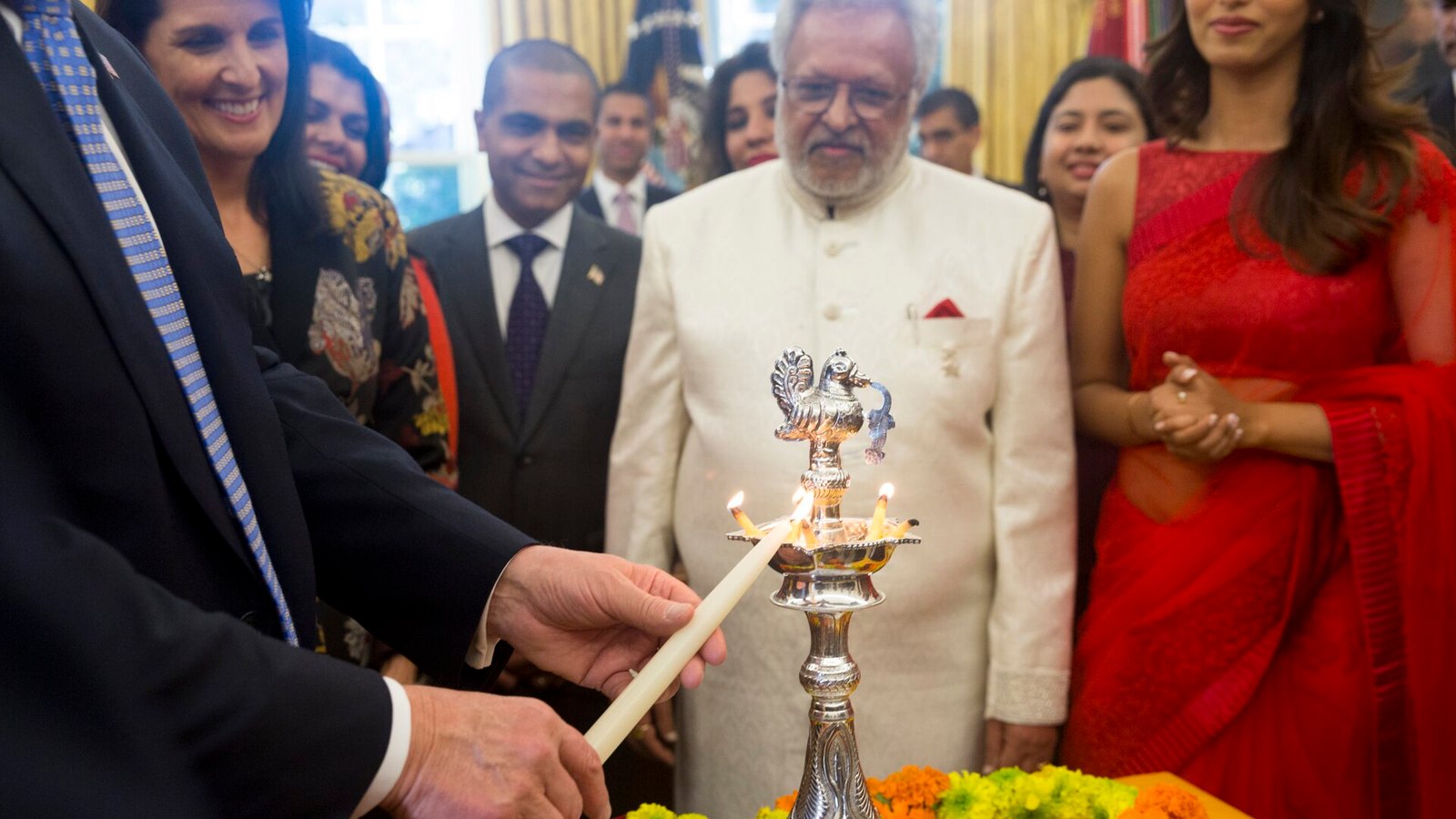
A tall brass lamp, a lit wick, a scatter of marigolds — and, handed across the Oval Office, a copy of the Hanuman Chalisa. When Donald Trump marked Diwali at the White House this week, the props were the familiar ones of the festival of lights. The guest list was something else: a short roll-call of how far, and how high, the Indian diaspora has climbed in American life.
The hymn came from Vishal Gondal, the Mumbai-born entrepreneur who founded the fitness company GOQii. Joining the president for a ceremonial lighting of the diya, Gondal presented him with a copy of the Hanuman Chalisa, the Hindu devotional hymn to Lord Hanuman. By his own account he offered a prayer for friendship between India and the United States, and for the triumph of light over darkness, and left Trump with a phrase that needs no translation in most Indian households: "Jug Jug Jiyo" — may you live long. A devotional text pressed into a president's hands beside the Resolute Desk is the kind of small, startling image that stands in for a larger shift.
A room that maps the diaspora
Because the shift was in the room. Among those who gathered for the celebration were India's ambassador to Washington, Vinay Mohan Kwatra; the IBM chief executive Arvind Krishna; the Michelin-starred chef Vikas Khanna; the director of the FBI, Kash Patel; the director of the National Institutes of Health, Jay Bhattacharya; and the former Canadian parliamentarian Ruby Dhalla.
Read the names slowly and they stop being a guest list and start being a map. Corporate power, in Krishna, who runs one of the oldest names in American technology. Cultural reach, in Khanna, who turned a childhood in Amritsar into a restaurant empire and a television career. Government itself, in Patel and Bhattacharya, two Indian-Americans running two of the most consequential agencies in Washington. Diplomacy, in Kwatra. And, in Dhalla, a reminder that the diaspora's story is continental, not national — that the same community produces members of parliament in Ottawa as readily as cabinet officials in Washington.
It is a long way from the margins. A generation ago, Indian faces in a room like that would have been the caterers or, at most, a single invited doctor. This week they were the guests of honour, the host's chosen company on one of the calendar's warmer evenings.
An old tradition, new company
The ritual itself is not new. George W. Bush began the practice of marking Diwali at the White House in 2003, lighting the first ceremonial diya there, and every administration since — Barack Obama's, Trump's first, Joe Biden's — has kept some version of it. What changes from year to year is not the lamp but the company around it, and the company is a fair barometer of a community's standing.
By that measure the barometer has risen sharply. The diaspora that Bush's White House acknowledged in 2003 was large and prosperous but still largely outside the machinery of American power. The one that filled the room this week sits inside it — in the C-suite, the kitchen, the agency, the ambassador's car.
The quiet diplomacy of a diya
There is a politics to these gestures, and it is not hidden. India has spent the past decade deliberately turning its overseas population into an instrument of statecraft — a source of investment, soft power and political voice in the countries where it has settled. A Diwali lamp lit at the White House, an ambassador in attendance, a devotional text accepted with a smile: each is a thread in the warm, carefully tended relationship between New Delhi and the world's most powerful capital. The diaspora is both the audience for that diplomacy and, increasingly, its instrument.
The courtship is bipartisan, which is part of what makes it durable. The same community that filled a Republican president's Oval Office this week had, days earlier, sent mostly Democrats to Congress and statehouses; its most prominent Republican stars — a former presidential contender in Ohio, the FBI director in the room — sit alongside a House caucus that leans heavily the other way. Both parties have done the arithmetic. A community that is affluent, concentrated in competitive states and reliably high-turnout is worth a Diwali invitation whoever is handing them out, and the invitations now come from both sides of the aisle.
The timing underlines the point. This is the same autumn in which the community sent a wave of firsts to American legislatures and a mayor's office — the first Sikh to the Georgia statehouse, the first Hindu woman to the Texas one, an Indian-origin mayor projected for Los Angeles. It is the same season in which India's foreign minister unveiled a bust of Sardar Patel before the diaspora in Atlanta. The Oval Office diya belongs to that sequence: a community being courted, at home and abroad, by governments that have worked out how much it is worth.
Whether such symbolism deepens the bond or merely decorates it is a fair question, and worth keeping open. A hymn accepted for the cameras is not a policy, and the warmth of a festival evening has a way of evaporating by Monday. But the people in that room did not arrive by invitation to a ceremony so much as by thirty years of building the lives that made the invitation inevitable. The lamp was lit for them, and by them.
That is the part that would have been hard to imagine in 2003. Diwali marks the return of the light, and the victory of its small, stubborn flames over a much larger dark. In an Oval Office this week, the people holding the lamp were the children and grandchildren of immigrants — no longer waiting at the edge of the room to be noticed, but standing at its centre, handing the president a prayer.
Sources: reporting on President Donald Trump's participation in a Diwali celebration at the White House, including the Oval Office diya-lighting with entrepreneur Vishal Gondal (founder of GOQii), Gondal's gift of a copy of the Hanuman Chalisa and his "Jug Jug Jiyo" blessing and prayer for India–US friendship — per ANI, Deccan Herald, ETV Bharat and Oneindia (7 November 2026). Attendees named in that reporting include Ambassador Vinay Mohan Kwatra, chef Vikas Khanna, IBM chief executive Arvind Krishna, FBI Director Kash Patel, NIH Director Jay Bhattacharya and former Canadian MP Ruby Dhalla. The White House Diwali tradition dates to President George W. Bush in 2003, per the public record.
Related from Politics
India opens the road to its biggest diaspora homecoming — and it runs through Kolkata
From a Mandi classroom to the mayor's chair: the student who came to Bendigo and stayed to lead it
A wave of firsts, and two defeats: the Indian diaspora's 2026 US midterm